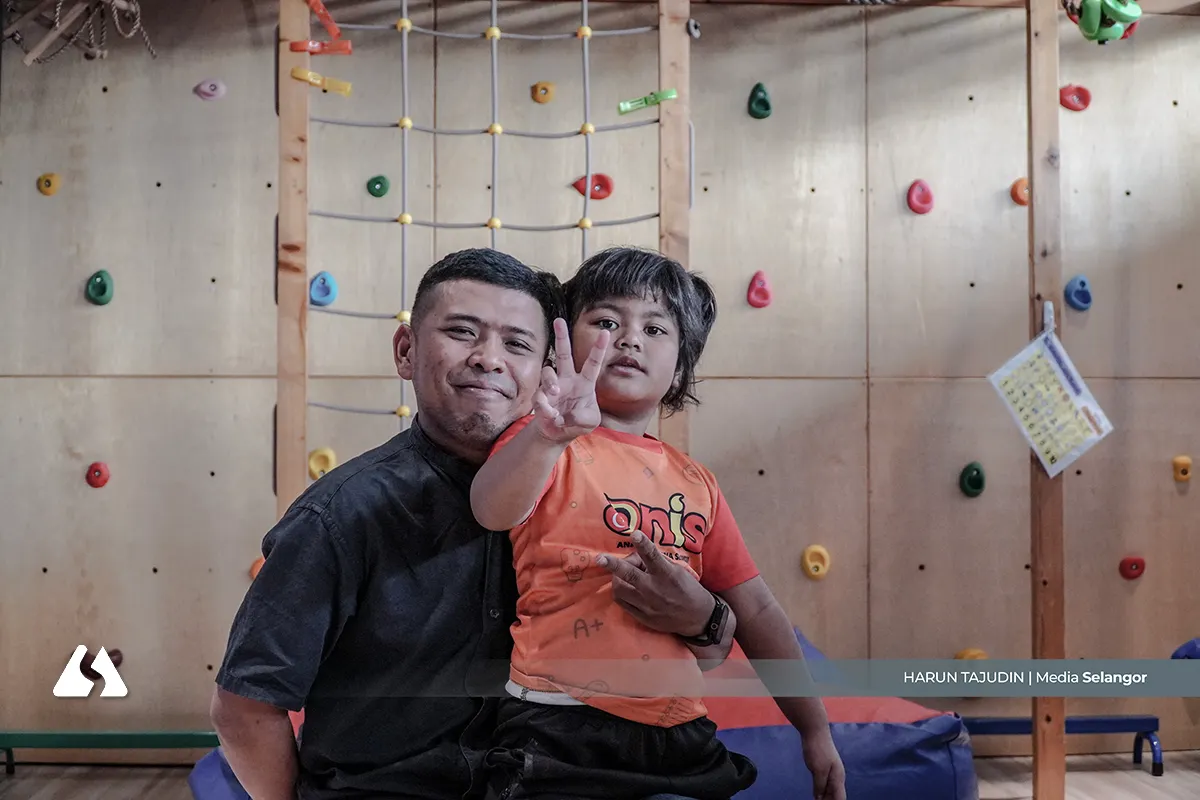
SHAH ALAM, Sept 26 — Every parent hopes to see their child grow up like other children — walking, talking, and eventually being able to care for themselves.
Yet for Muhammad Anas Ahnis, raising his firstborn took him and his wife through an experience they had never imagined.
When Aulia was diagnosed with autism and attention deficit hyperactivity disorder (ADHD) at the age of three, the 35-year-old admitted that he found it difficult to accept the diagnosis.
Initially, Anas thought his child’s developmental delay was simply a normal phase. However, after noticing differences between Aulia and other children of the same age, he decided to seek a specialist assessment.
Among the early signs he noticed were her slowness to walk, difficulty communicating, and reliance on gestures to express what she wanted.
“When our child was first diagnosed, we really could not accept it. We were deeply saddened. But as parents, we had to accept the situation and find a solution.
“People told us to reflect on ourselves. That was why we quickly sought help and did whatever we could at home while waiting for other support,” he said.
From feelings of sadness and shock, Anas and his wife began learning to understand their child’s condition.
Guidance from doctors eventually led the family to Yayasan Insan Istimewa Selangor (YANIS), opening up opportunities to access therapy, attend parenting courses, and receive financial assistance. Their efforts gradually began to bear fruit.
The therapy programme Aulia attended also showed positive progress, with the child now increasingly able to communicate, learn to write, and carry out several daily activities more independently.
“Before this, my child relied heavily on sign language because she could not tell us what she wanted. Now she can speak, choose her own food, write, and cook under supervision,” he said.
For Anas, raising a child with autism requires not only patience but also a significant financial commitment.
He once explored the subject and found that private therapy could cost between RM2,000 and RM3,000. At the same time, the family spends around RM500 to RM1,000 a month on learning needs, fine motor development activities, therapy materials, and Aulia’s hobbies.
Support from YANIS has helped ease the burden to some extent, allowing the family’s budget to be channelled towards the child’s development.
“When we receive support from YANIS, that budget can instead be used for our child’s learning needs.

“There are many initiatives by the Selangor government to help parents, especially those who do not know how to care for a child with autism,” Anas said.
He does not keep the knowledge he gained from the courses he attended to himself. Whenever he meets families going through a similar experience, Anas tries to share the knowledge and experiences he has gained.
However, one thing that still weighs on his mind is how members of the public react when Aulia has a tantrum in public places.
The father of two hopes that people will not be too quick to make assumptions about children or parents facing such situations.
“If possible, offer whatever help you can because the parents may need assistance at that moment. Society also needs to have empathy and understand the situation because we do not know what those parents are going through,” Anas said.
Full of potential
Seeing Aulia’s progress today has given him confidence that autistic children have potential when provided with education, opportunities, and continuous support.
However, as a father, one concern always remains at the back of his mind: who will care for his child when he and his wife are no longer around?
Therefore, Anas hopes more avenues for education, skills training, and employment opportunities will be created so autistic individuals can build independent lives as they reach adulthood.
“Children with autism do have a future; they have hidden talents. I hope there will be more educational and career opportunities so that they have a clear direction when they grow up,” he said.
For parents who have just received a diagnosis for their child, Anas understands that the early stages may be filled with questions, sadness, and anxiety, just as he experienced.
However, his journey with Aulia has taught him that change does not happen overnight. It requires patience, knowledge, and repeated effort.
“Be more patient and always be consistent. Caring for a child is tiring, but we have to put that aside.
"As parents, we must always keep learning, attend workshops, and apply what we learn at home, as well as spend time with our children,” Anas said.