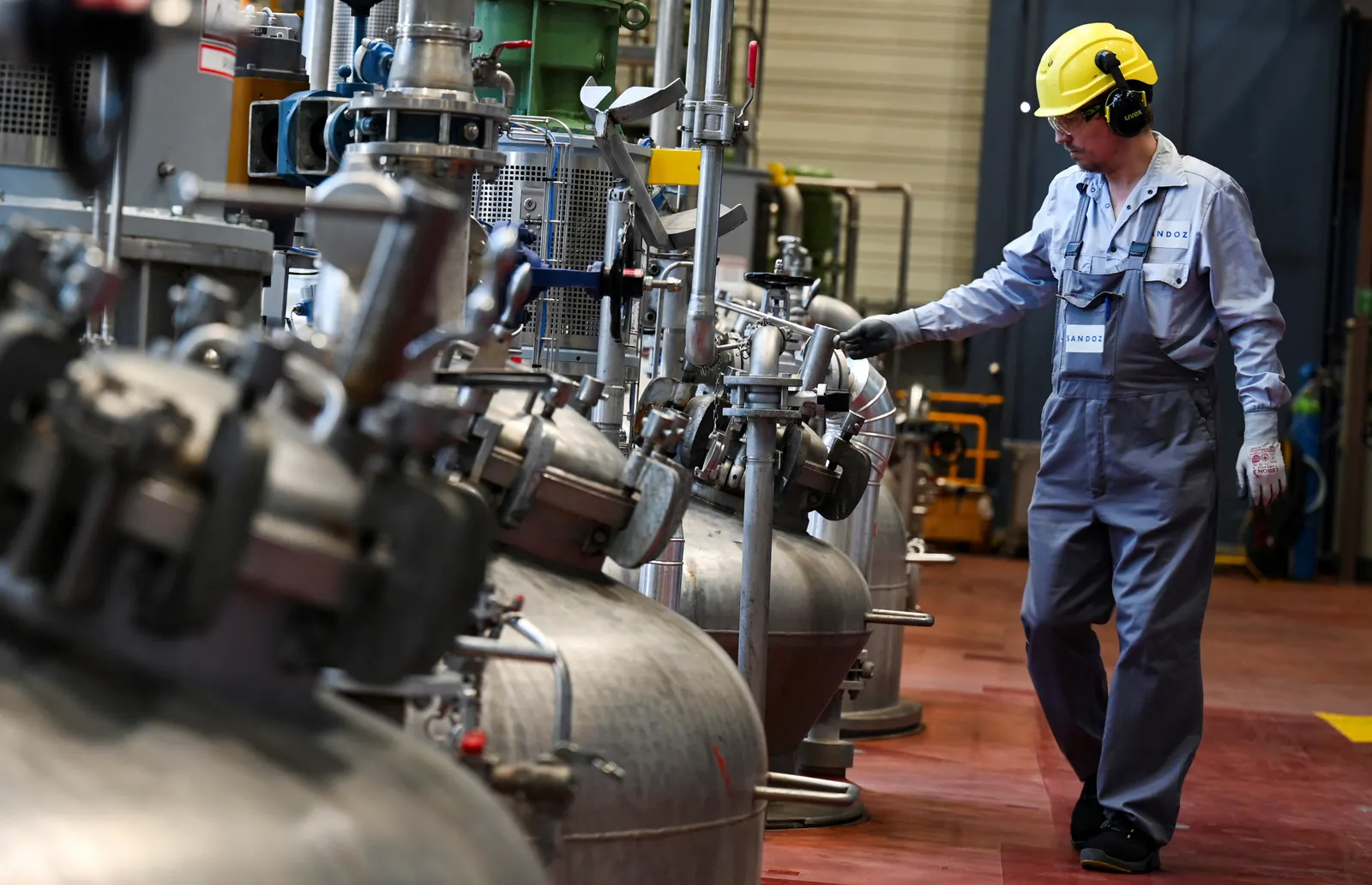

KUNDL, Oct 21 — Tucked away in the green foothills of the Austrian Alps, the last fully integrated European penicillin plant faces an uncertain future in the shadow of rising Chinese industrial power.
The reason: China is churning out the same antibiotics and ingredients as the Sandoz factory in Kundl, Austria, at much lower cost for the European market.
The falling prices are a boon for cost-conscious European governments' public healthcare programs but an existential threat to the Kundl site — the only one making penicillin from start to finish in Europe, including key active ingredients.
After several peers announced they were closing or moving production to China, the plant has become a focal point for a widening debate about the West's self-sufficiency.
And, just three years after a €200-million (RM916.9 million) expansion that included €50 million (RM229.2 million) of public funds, Sandoz has asked the European Commission to open an anti-dumping investigation that could result in tariff measures against Beijing.
In offices overlooking the plant's gleaming storage tanks, ringed by the Tyrolean Alps, Kundl site manager Stephanie Jedner told Reuters that if the plant went out of business, Europe "would be fully dependent" on China.
Alexander Fleming discovered penicillin a century ago in London, and it remains the main antibiotic class for life-threatening infections. Today, China dominates the manufacture of ingredients for some 1.5 billion daily doses Europe administers each year.
Eurostat data revealed that China's share of European Union (EU) imports of penicillins and their derivatives in mostly bulk active pharmaceutical ingredient (API) form has nearly doubled from 44 per cent in 2019 to 86 per cent last year, coinciding with Beijing's "Made in China" 10-year plan to move up the global manufacturing value chain.
Meanwhile, Europe's exports of the same are now barely a fifth of their early-2000s peak.
It is one example of how China has graduated from textiles and assembly plants to advanced manufacturing and traditionally European industries, from pharmaceuticals to machine tools. With the EU goods trade deficit with China ballooning to around €1 billion (RM4.58 billion) per day in 2025, double the level of 2020, policymakers are scrambling for new measures to protect companies and jobs.
In written evidence to United Kingdom lawmakers earlier this year, Sandoz said that Kundl's capacity to supply Europe is "not commercially sustainable" unless governments paid more for penicillin. It argued that Beijing's control of the penicillin supply chain creates an "inherent strategic risk" akin to China's stranglehold on critical minerals.
"Antibiotic supply could feasibly become a tool of economic coercion or hybrid warfare, particularly during periods of diplomatic tension," Sandoz wrote in the submission to lawmakers, asking for more support.
Medicine as leverage in trade wars
China spent years establishing itself as a reliable supplier of essential medicines and is increasingly a player in cutting-edge pharmaceuticals. Sandoz says up to 90 per cent of global antibiotic active ingredients are now produced outside Europe, mainly in China, or in India with Chinese chemicals.
"This is something that you should worry about, because China's market power gives it leverage to defend strategic interests," said the EU foreign policy think tank European Union Institute for Security Studies' China analyst Tim Rühlig.
China could face reputational damage if it used such leverage. Unlike its near monopoly over rare-earth refining, Chinese policy does not frame power in the antibiotic market in national-security terms.
Nonetheless, Chinese economist Daokui Li, a former member of the Chinese central bank's monetary policy committee, spooked Western nations during the COVID-19 pandemic when he suggested API supplies should be on the table in trade disputes.
One United States (US) official in China, speaking on condition of anonymity, told Reuters that Chinese counterparts had suggested in meetings that Beijing could cut off exports of APIs for some medicines as retaliation in a trade conflict.
The Chinese Foreign Ministry said it can resolve economic and trade differences with the EU through dialogue and consultation.
"China consistently opposes all forms of trade protectionism," it said in response to Reuters questions. The US State Department did not immediately provide comment.
Slovenia-based pharmaceutical contract research and development firm Labena's business development head Boštjan Čeh said that for European policymakers, the decline of such a strategic industry leaves the bloc vulnerable to supply restrictions during pandemics or conflicts.
"It would seriously compromise Europe's ability to cope with a health crisis," he said.
The Medical University of Plovdiv's policy expert Anna Mihaylova said that only after the COVID-19 pandemic — when Europe noticed its dependence on Asian medical supplies — did policymakers begin treating pharmaceutical output as a strategic matter.
Alarm bells sounded in 2022, when supplies of amoxicillin, the penicillin type made at Kundl, ran low in Europe during a surge in respiratory infections after the pandemic.
A year later, citing repeated shortages, the European Commission approved €28.3 million (RM129.7 million) toward the Kundl expansion, which raised production capacity by 20 per cent.

Shifting dependencies
Wearing a white coat and safety goggles, Sandoz's manufacturing unit in Kundl's head Cecile Stolz demonstrated in a small vial how green mould is cultivated to make the compound Scottish scientist Fleming in 1928 found destroyed harmful bacteria.
Fleming's discovery won him a Nobel Prize. For years after, China depended heavily on Europe to produce penicillin and other generic drugs.
However, Rühlig said that Beijing's industrial investment has now reversed the roles. China's newfound dominance also stems from fewer environmental regulations, drastically lower labour costs, state subsidies, and investment by Western pharmaceutical companies seeking cost savings.
At the Sandoz site, which employs more than 2,000 people, Stolz's team ferments nutrients in metal vats to produce the penicillin. The process is energy-intensive, another factor making Europe's producers less competitive: the International Energy Agency statistics show that EU electricity prices for energy-intensive industries averaged nearly 50 per cent above China in 2025.
Speaking at the site Sandoz shares with former parent Novartis and chemicals maker BASF, Jedner noted that Europe's high energy costs are acutely felt at the Kundl plant, which uses as much energy as the nearby city of Innsbruck, home to over 130,000 people.
She said that as energy prices rise, Europe's penicillin prices have been flat or falling.

Cheap antibiotics, but at what cost?
Sandoz complains it cannot raise prices because of competition and European countries' procurement processes.
The Kundl plant remains vulnerable because European governments procure medicine based on the lowest price rather than seeking to maintain diverse supplies.
It argues that China is flooding the market with cheap APIs. In March, it filed a complaint to the European Commission about China's hold on parts of the antibiotics market.
The case centres on proving Chinese amoxicillin APIs are being sold in Europe below production cost, propped up by subsidies.
EU trade experts, European officials, and China scholars told Reuters that the European Commission (EC) is expected to open the anti-dumping probe soon, though timing remains unclear because of a backlog of complaints.
They added that EU duties are likely, as Europe is hardening its approach to China more broadly. Of 23 ongoing EU anti-dumping and anti-subsidy investigations, all but three have China as the sole or joint target.
The EC declined to comment.
Other outcomes are possible. European Trade Commissioner Maroš Šefčovič recently announced a deal with Beijing to lower its exports of hybrid vehicles rather than imposing tariffs, a bid to salvage Europe's automakers.
In public statements, Beijing says its subsidy support is in line with World Trade Organisation rules. It accuses other countries of protectionism hurting global supply chains.
As Sandoz struggles with global trade dynamics, its chief executive officer Richard Saynor said that to be sustainable, the life-saving medicines need more pricing power than everyday candy.
"I find it upsetting that we sell a pack of antibiotics more cheaply than a packet of Ricola in Switzerland or a Mars Bar in the UK. We take a lot of these things for granted — and we take them for granted until they are no longer around," he told Reuters.