SHAH ALAM, Aug 29 — Scam victims should set aside panic, shame and regret, and act immediately, as the first hour after a fraudulent transaction could be crucial in stopping the money from reaching the perpetrators.
Selangor Commercial Crime Investigation Department (CCID) deputy head assistant commissioner Izwan Abd Karim said swift action could enable authorities to block transactions and trace the flow of funds, provided the money had not yet been withdrawn.
“For individuals who have been victims of scams, first of all, do not panic. Victims have a period of about an hour which we call the golden hour.
“During that period, several actions need to be taken immediately,” he said in the ‘Bicara Semasa’ programme by Media Selangor.
Izwan urged scam victims to contact the National Scam Response Centre (NSRC) at 997 immediately to enable swift coordination with the relevant banks.
He said prompt action could help block the transaction and trace the movement of funds before the money was withdrawn or transferred to other accounts by the syndicate.
phone scam.jpg
phone scam.jpg
Prompt action is a must
Apart from contacting the NSRC, Izwan advised victims to immediately call their bank’s official hotline to report any suspicious transactions and request appropriate action on the affected account or transaction.
He also urged victims to lodge a police report immediately at the nearest police station.
He said swift action was crucial as modern fraud syndicates operated in a highly organised manner, with established networks to manage and move the proceeds of their crimes.
Izwan also likened the structure of today’s scam syndicates to that of a multinational company, with specialised roles ranging from call centre operators and money mule account managers to technical and cyber teams and money laundering units.
He said proceeds from fraudulent activities could pass through multiple layers of transactions, be converted into assets or cryptocurrencies, or channelled through seemingly legitimate businesses.
What is more concerning, Izwan pointed out, is that the entire process could take place within just a few minutes.
All ages can be a victim
Meanwhile, Izwan also warned that the public should not assume that scam victims are limited to senior citizens or those who are less familiar with technology.
Izwan said advances in technology had enabled scammers to target people regardless of age, education or socioeconomic background.
He highlighted that young people, students, and working professionals were also falling victims to scams, with syndicates believing they had accumulated substantial retirement funds and savings.
Among the scams frequently reported were bogus investment schemes, e-commerce fraud, phone scams, bogus loan offers, love scams, and e-financial scams.
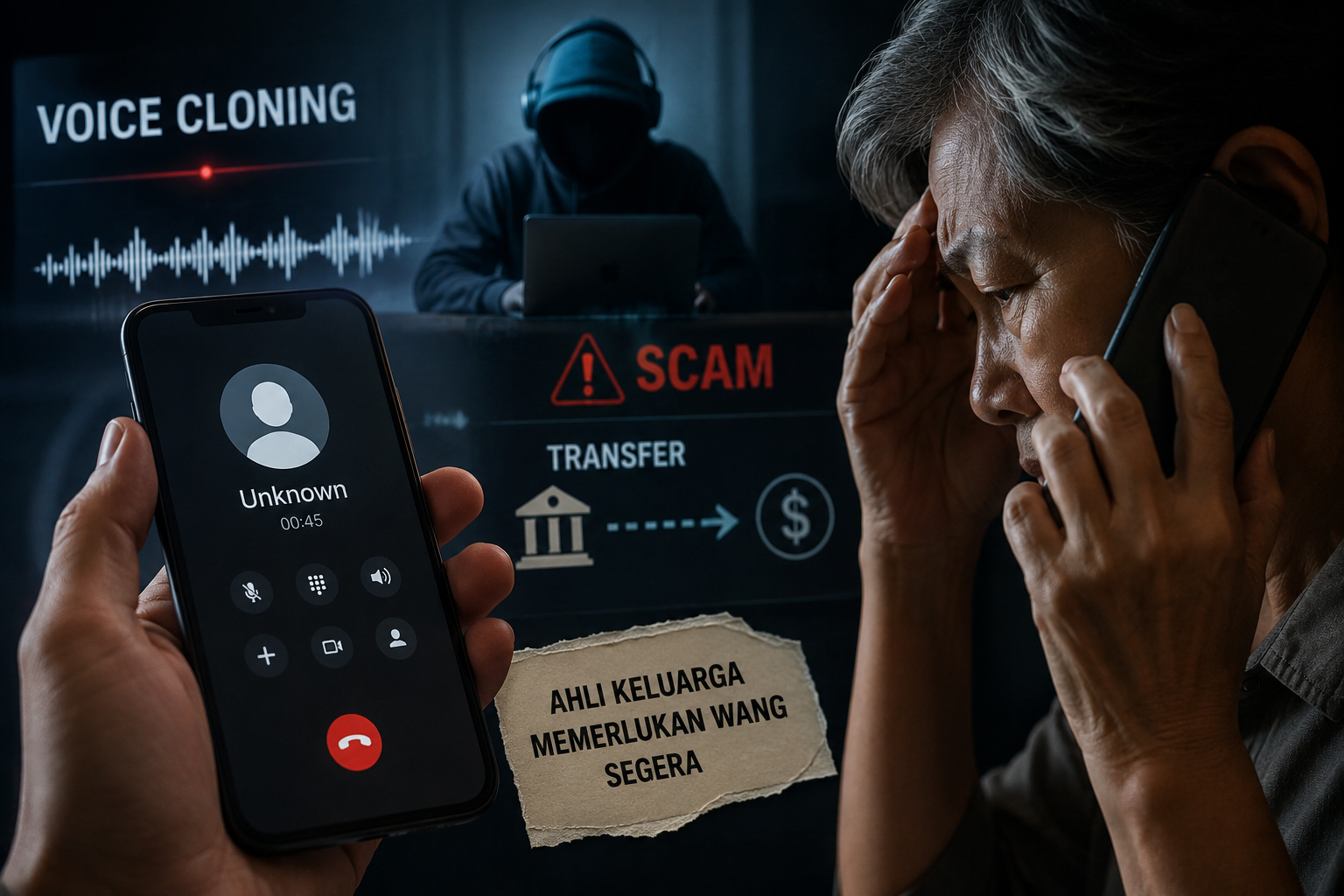
Izwan said syndicates were also becoming increasingly sophisticated by exploiting current developments and using technologies such as voice cloning, deepfake videos, and caller ID spoofing to make their impersonations more convincing.
Check, Block, Verify
To help prevent scams, Izwan urged the public to adopt the 3S principle—’Semak, Sekat, Sahkan’ (Check, Block, and Verify).
He said members of the public should check suspicious websites, applications, and accounts including through the ’Semak Mule’ facility provided by the Royal Malaysia Police (PDRM).
They should also block suspicious calls and numbers and avoid clicking on links received from unknown sources.
Izwan advised the public to verify any calls purportedly from government agencies, banks or enforcement authorities by contacting the relevant agency through its official hotline before taking further action.
He also reminded the public never to disclose confidential information such as PINs, passwords, and one-time passwords (OTPs), or allow their bank accounts to be used by others, as this could result in the accounts being exploited as mule accounts.
Most importantly, Izwan urged those who have fallen victim to a scam not to delay taking action.