

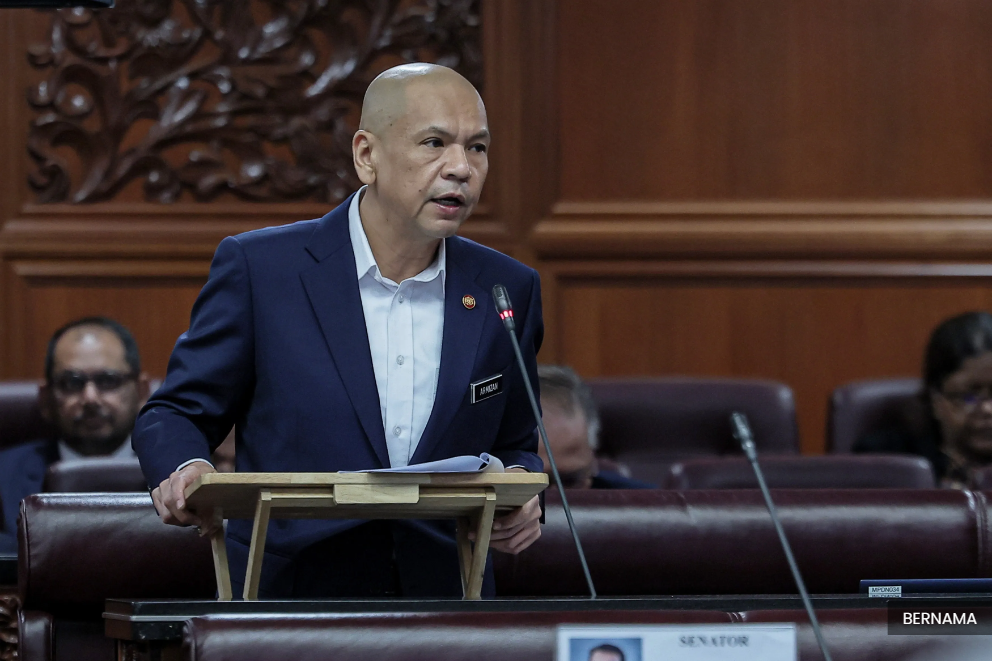

KUALA LUMPUR, June 25 — The government is drafting a new legal framework for e-commerce platforms to strengthen platform accountability, address regulatory gaps, and better protect local micro, small and medium enterprises.
Domestic Trade and Cost of Living Minister Datuk Armizan Mohd Ali said the study on the proposed legislation began in April 2024, with the final report now available on the Domestic Trade and Cost of Living Ministry's (KPDN) website.
KPDN has also prepared a Cabinet memorandum on the proposed policy, which is expected to be tabled at the first Cabinet meeting in July.
"The next step will be the preparation of the Bill, taking into account the views of all ministries as well as the Attorney General's Chambers," he said during a Special Chamber sitting in the Dewan Rakyat today.
Armizan was responding to Bentong MP Young Syefura Othman's query on government initiatives to support e-commerce businesses, including measures to address unequal market access and curb the proliferation of counterfeit goods.
He added that the proposed legislation was prompted by regulatory gaps between local businesses and foreign cross-border sellers, with the aim of creating a fairer competitive environment, strengthening platform accountability, and tackling counterfeit products.
Businesses operating through e-commerce platforms in Malaysia remain subject to local laws, including those administered by other ministries.
However, the government does not currently require all foreign sellers to establish a registered company or business entity in Malaysia, as cross-border e-commerce spans multiple international jurisdictions and raises issues relating to enforcement, compliance and trade commitments.
Armizan said that KPDN's existing laws are territorial in nature and do not provide for direct extraterritorial enforcement against foreign sellers that do not have a registered entity in Malaysia.
To address this, the government is studying mechanisms to strengthen platform accountability, including requiring overseas entities to comply with Malaysian laws, appointing authorised local representatives, enhancing platform operators' accountability, and extending the law's extraterritorial application where appropriate.
On counterfeit goods, the minister said KPDN received 38,503 complaints related to online transactions between 2023 and June 11 this year.
Together with e-commerce platforms, Internet service providers, and the Malaysian Communications and Multimedia Commission, it has strengthened cooperation to tackle online offences.
Between January 1 and May 31 this year, 412 websites were blocked for various offences, including the sale of counterfeit goods, while 57 online advertisements were taken down through cooperation with e-commerce platforms.
Meanwhile, the Malaysia Competition Commission continues to monitor anti-competitive practices under the Competition Act 2010, adding that no cases of predatory pricing involving foreign sellers have been recorded in the e-commerce ecosystem to date.
Citing the Department of Statistics Malaysia, he said the e-commerce sector contributed RM248.2 billion, or 13.6 per cent, to Malaysia's gross domestic product in 2023.
The sector's total revenue has continued to grow, rising from RM1.1 trillion in 2021 to RM1.13 trillion in 2022, RM1.18 trillion in 2023, RM1.23 trillion in 2024 and RM1.3 trillion in 2025.