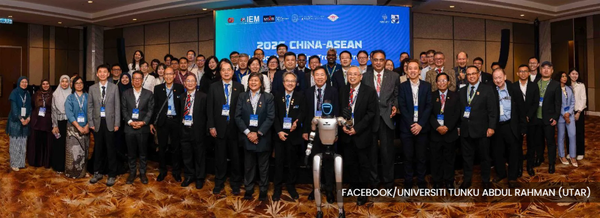
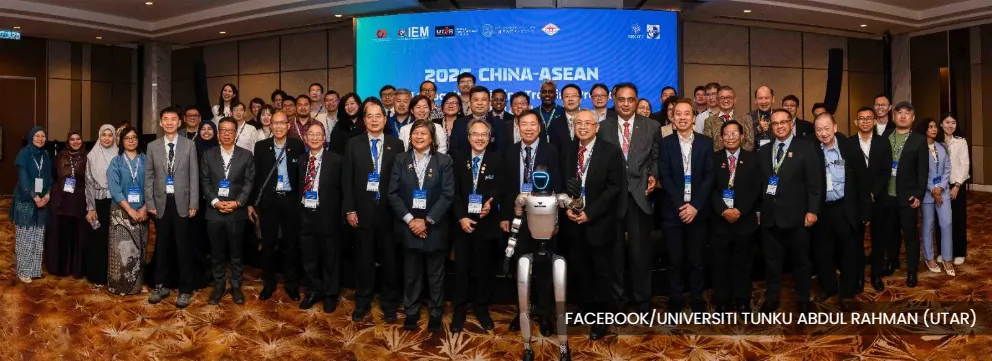
KUALA LUMPUR, Jan 25 — Experts from China and across the Asean grouping gathered for the 2026 China-Asean AI Capacity-Building Training Programme and High-Level Seminar on AI Frontier Technologies and Governance to discuss cooperation and capacity building.
Xinhua reported that the gathering of over 100 representatives on Friday (January 23) worked to find common ground and exchange views on frontier artificial intelligence (AI) technologies and security challenges, against the backdrop of rapid technological change and rising governance concerns.
The Chinese Academy of Sciences' Institute of Automation professor cum the Chinese Association of Automation's vice president Hou Zengguang said that the deep integration of AI with automation and digital technologies is reshaping the global development landscape and profoundly influencing production and daily life.
He noted that China has accumulated rich experience in research, technology development and industrial application in the field of automation, which can contribute to global scientific and technological advancement.
Meanwhile, UNESCO Regional Office for East Asia's director and representative Shahbaz Khan said AI is reshaping industries, societies, and global cooperation patterns.
He said that although it offers unprecedented opportunities, it also poses profound challenges, adding that promoting inclusive cooperation and building a fair and equitable AI governance system is a shared task for all stakeholders.
Similarly, the Federation of Engineering Institutions of Asia and the Pacific's president Aung Kyaw Myat said that Asean countries stand at a critical juncture, and that AI capacity building must be a priority.
For his part, Universiti Tunku Abdul Rahman president Ewe Hong Tat said that AI is rapidly influencing economic structures, public services, national security, and societal well-being.
"While its potential is immense, it also raises important questions relating to governance, ethics, cybersecurity, standards, and public trust. These challenges cannot be addressed by any single institution or nation alone, and they require close alignment between government, academia, industry, and international partners," he said.
During the seminar, roundtable discussions were also held on AI education and capacity-building, as well as the prospects for China-Asean AI cooperation.