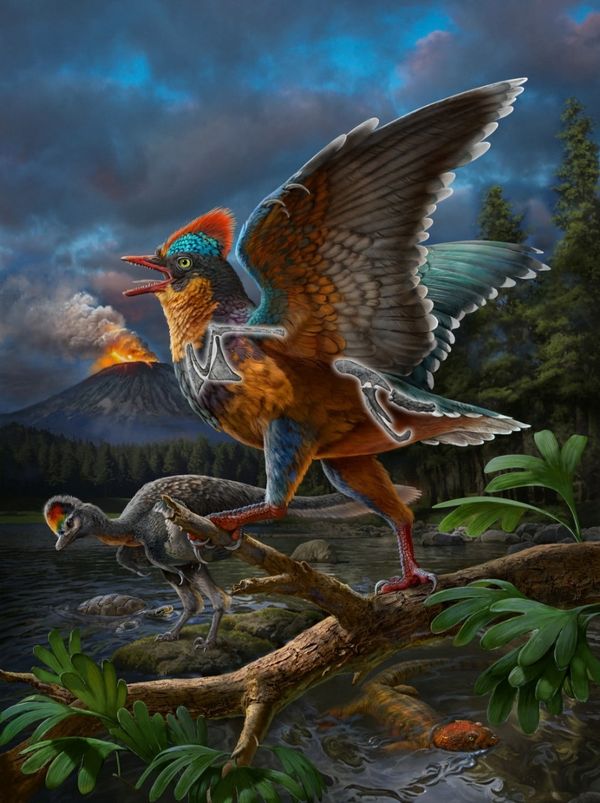

WASHINGTON, Feb 13 — Scientists have unearthed in southeastern China the fossil of a quail-sized bird that lived about 150 million years ago during the Jurassic Period and possessed surprisingly modern traits, a discovery that rewrites the history of avian evolution.
The newly-identified bird, called Baminornis Zhenghensis, joins the similarly aged Archaeopteryx, discovered in Germany in 1861, as the oldest-known birds. But Baminornis, about 15 cm long, was far more advanced anatomically and a better flier than crow-sized Archaeopteryx, a creature seemingly half bird and half reptile.
While Archaeopteryx boasts a long and skinny tail resembling a raptor dinosaur like Velociraptor, Baminornis has the shortened tail of a modern bird — an important aerodynamic innovation that helps shift the body's center-of-mass forward toward the wings.
The fact that the two earliest-known birds display quite different anatomies and inhabited different parts of the world — separated by about 8,800 km — suggests that millions of years of avian evolution had already occurred before their appearance.
Birds evolved from small feathered dinosaurs. Based on the new discovery, the first birds arose 172 to 164 million years ago, millions of years earlier than previously believed, according to paleontologist Min Wang of the Institute of Vertebrate Paleontology and Paleoanthropology of the Chinese Academy of Sciences, lead author of the study published yesterday in the journal Nature.
"Baminornis Zhenghensis looks more like modern birds than Archaeopteryx," Wang said, calling its discovery "a landmark to me and other evolutionary biologists".
Until now, Archaeopteryx was the only unquestionable bird known from the Jurassic, which ended roughly 145 million years ago.
The Baminornis fossil was discovered in 2023 during scientific fieldwork in Fujian Province's Zhenghe County. The fossil preserves much of the bird's skeleton but lacks the skull, leaving a gap in the understanding of its diet and lifestyle that could be interpreted from its jaws and teeth. Wang said Baminornis probably had teeth, as did Archaeopteryx.
Baminornis lived in a swampy area alongside the meat-eating dinosaur Fujianvenator as well as various semi-aquatic reptiles, turtles and fish, based on other fossils found in the area.
The 19th century discovery of Archaeopteryx, now known from about a dozen specimens, lent support to British naturalist Charles Darwin's ideas about evolution and provided evidence that today's birds descended from dinosaurs. Archaeopteryx was, as University of Edinburgh paleontologist Steve Brusatte put it, "the textbook example of a creature caught in the act of evolution, like a freeze frame".
"Yet, for more than 150 years now, Archaeopteryx had stood alone. During all of that time it had remained as the only unquestionable bird fossil from the Jurassic Period," said Brusatte.
"Baminornis tells us that a variety of birds lived during the Jurassic, and they flew in different ways. There was a bevy of birds flying overhead of Allosaurus and Stegosaurus and Brontosaurus and the other iconic Jurassic dinosaurs," Brusatte added.
— Reuters