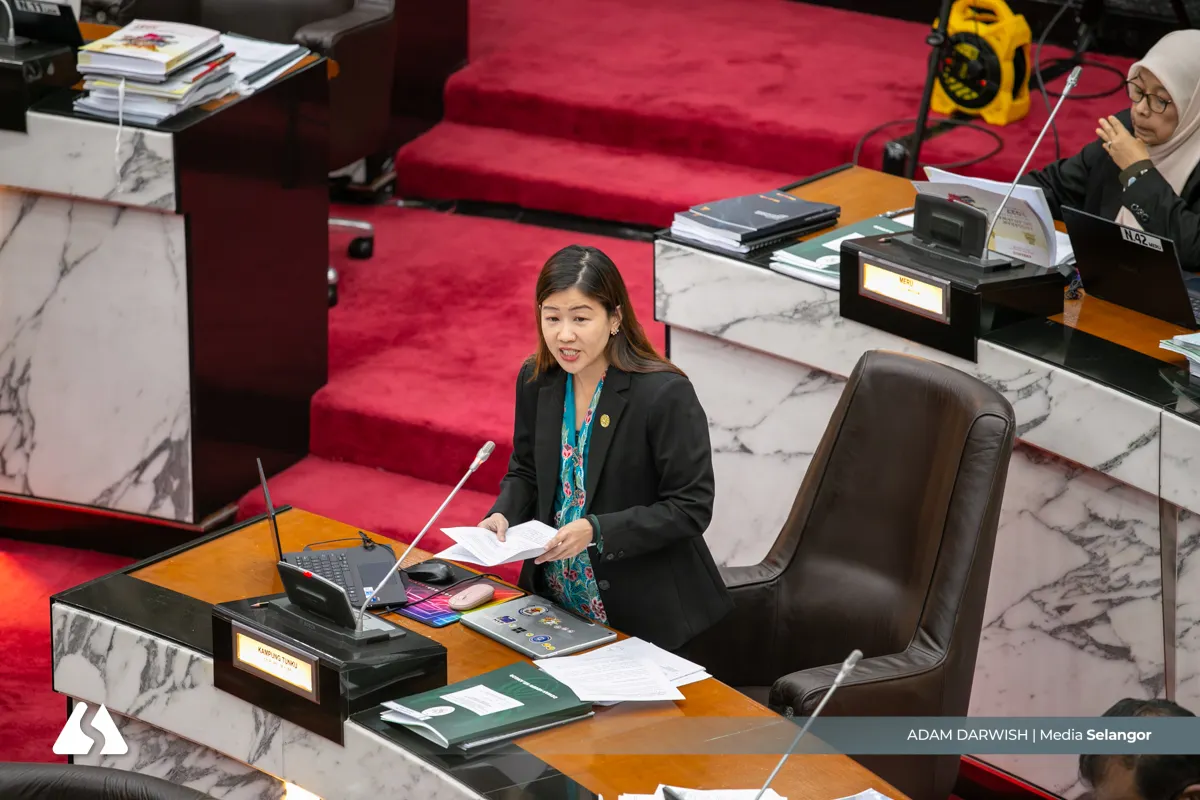
SHAH ALAM, Nov 18 — Kampung Tunku assemblyman Lim Yi Wei today urged the Selangor government to clarify whether its flood mitigation and drainage projects are designed to withstand climate change, and questioned the role and effectiveness of the Selangor Climate Adaptation Centre (SCAC).
She said the state should provide details on SCAC’s targets, key performance indicators (KPIs) and plans for 2027, including whether the centre has provided scientific advice for flood mitigation and drainage projects under the state budget.
“Many assemblymen have raised issues concerning flood mitigation projects and drainage problems. Kampung Tunku would like to bring up a new topic: what is the role of SCAC in addressing floods?
“One year after its establishment, what has SCAC delivered? Where is the science? Are the flood mitigation and drainage projects in this budget resilient in the long term, or are we just playing catch-up with climate change? Have these projects received advice from SCAC?
“We would therefore like specific details on SCAC’s KPIs and achievements this year, as well as its plans and KPIs for 2027,” she said when debating the 2027 Selangor Budget at the Selangor State Legislative Assembly today.
How has SCAC helped?
Lim also asked how SCAC has guided local councils in the preparation of their climate action plans, when the plans would be completed, and how funding gaps between councils would be addressed, and said the state should establish clear benchmarks to ensure plans are implemented.
She questioned whether SCAC has studied the impact of haze on Selangor’s agriculture sector and public health, and urged it to take on a stronger role in climate advocacy and policymaking.
In May last year, SCAC was established as Malaysia’s first state-level climate governance centre to strengthen data-based responses for the escalating climate crisis and to serve as a research and coordination hub that guides proactive climate policy, planning, and cross-sector collaboration.
On urban development, she called for a review of the state’s 10 per cent green space requirement for new developments, aimed at mitigating surface runoff that contributes to urban flooding.
Citing Singapore’s Landscaping for Urban Spaces and High-Rises (LUSH) policy, she said the state should consider requiring new stratified developments to replace every square metre of lost surface greenery with an equivalent area of vertical or rooftop greenery.
Govt’s success determined by effective flood mitigation
“Does the state government have the political will to change and enforce its planning approval requirements?” Lim asked, as she said residents would ultimately judge the Selangor administration by its ability to resolve recurring floods, despite various other initiatives and allocations it has introduced.
“After the first visit to a relief centre, people may be grateful. The second time, they begin to grow weary. By the third time, they will be angry with us,” she said.
Meanwhile, she proposed expanding the Ambulans Kita Selangor service to emergency cases, citing a study published in the Medical Journal of Malaysia on out-of-hospital cardiac arrests between 2010 and 2019.
She said the study found that the survival-to-hospital-admission rate in the Klang Valley was about 4 per cent.
Lim highlighted the time taken to make emergency calls after cardiac arrests, saying the Klang Valley averaged 28 minutes, compared with two to three minutes in Japan, South Korea and Singapore.