SINGAPORE/SEOUL, Nov 6 — Global investors are pressing South Korea's biggest conglomerates to speed up corporate governance reforms, saying progress has been uneven, with gains in financials offset by resistance among large chaebol affiliates.
Despite a blistering rally this year, South Korea's market remains one of the world's cheapest. The index is up 35 per cent for the year even after a wrenching drawdown since the summer — at one point it had more than doubled — and after selling off it trades on a forward price-to-earnings ratio of about 3.85 times, compared to 17.64 times for MSCI World.
According to LSEG data, about 70 per cent of KOSPI stocks trade at or below book value. Samsung Electronics illustrates the persistent discount.
It reported the biggest quarterly operating profit by any technology company in history in the third quarter, yet trades at 1.87 times book value, versus 7.8 for Micron, 29 for Nvidia, and 44 for Apple's.
Reforms aimed at attracting more overseas investors remain a work in progress, contributing to investor outflows from Seoul and raising concerns that the momentum behind President Lee Jae Myung's drive to eliminate the so-called Korea Discount could stall.
"Banks, or financial holding companies, are moving as they planned according to their value-up plans.
"That said, large-caps — mainly chaebol affiliates — are resisting the corporate governance reforms recently, and their lobbying has picked up dramatically," said Seoul-based Korean Corporate Governance Forum chairman Namuh Rhee.
Some investors have argued that some conglomerates, particularly Samsung, should return more profits to shareholders, simplify their corporate structures, and implement strategic changes or divest from underperforming subsidiaries.

Samsung under pressure
Samsung Electronics board chairman Shin Je-yoon met investors overseas before last month's earnings announcement. A person briefed on the matter told Reuters that the meeting followed complaints about the company's shareholder return policy from global investors including Capital Group, Artisan, and Fidelity.
The source added that investors argued the returns were too modest and said they preferred share buybacks and cancellations to higher dividends. The meeting and details of the discussions are reported here for the first time.
In a statement, Samsung said that Shin regularly meets major global investors as part of its shareholder engagement efforts. It keeps an ongoing dialogue with key shareholders to understand a wide range of views on shareholder returns and capital allocation.
Capital Group, Artisan, and Fidelity did not respond to requests for comment.
In August, Samsung declared a record ₩30 trillion (RM89.85 billion) in dividends but said it would decide in January how to deploy the remaining ₩55 trillion (RM164.7 billion) to ₩75 trillion (RM224.6 billion) earmarked for shareholder returns.
That contrasts with rival SK Hynix, which announced a US$75 billion (RM304.4 billion) shareholder return package last month, including dividends, share repurchases, and cancellations. Together, Samsung Electronics and SK Hynix account for slightly more than half of the KOSPI's market capitalisation.

Changes to the law
A law that took effect in March made cancellation of treasury shares compulsory by September next year. Critics say such shares can be used as a takeover defence.
Some sectors, particularly financials, have been rewarded by the market for cancelling such shares.
A gauge of Korean bank shares is up 15.9 per cent this year, and insurers have gained 48 per cent, compared with declines of 42 per cent for shipbuilding and 30 per cent for machinery.
Non-financial sectors have been more reluctant to embrace shareholder-friendly measures, and Samsung Group has drawn particular investor ire, even as Samsung Electronics has benefited from the artificial intelligence boom.
Activist challenge
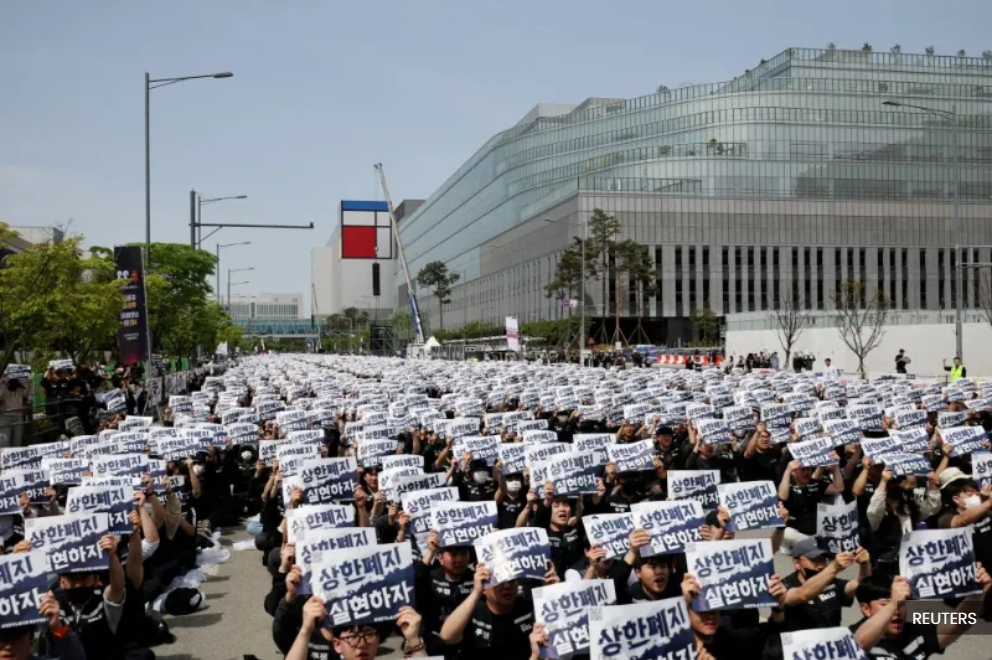
Samsung, South Korea's biggest chaebol, has faced growing pressure from activist investors seeking to capitalise on the government's push for governance reform and changes to the country's Commercial Law.
Seoul-based Life Asset Management said it had asked Samsung's board special committee and Samsung's Compliance Committee to independently review the decision to defer using the remaining funds until the end of January.
The asset manager said the review should examine whether delaying the decision was in shareholders' best interests, whether potential conflicts of interest were properly managed, and whether the remaining funds could realistically be deployed before the end of this year.
Palliser Capital, an activist fund run by James Smith, a former head of Elliott Management's Hong Kong office who has taken on Samsung in the past, has called for preferred-share repurchases and cancellations to be included in shareholder return policies at both Samsung and Hyundai Motor.
Meanwhile, an activist campaign led by Singapore-based Flashlight Capital calling on Samsung Group to boost returns at its security affiliate S-1 Corp has been largely rebuffed, although a ₩450 billion (RM1.34 billion) share buyback announced last month has lifted its shares.