KUALA LUMPUR, Oct 21 — Malaysia has maintained its elimination of mother-to-child transmission (EMTCT) status for the Human Immunodeficiency Virus (HIV) and syphilis for the 2021-2024 period, extending a public health achievement recognised by the World Health Organisation (WHO) since 2018.
The Health Ministry (MOH) said the recognition was presented at the 77th Session of the WHO Regional Committee for the Western Pacific (77RCM WPR) in Manila, the Philippines, which began on Monday (October 19) and runs until tomorrow.
“This achievement continues Malaysia’s outstanding record since 2018, when it became the first country in the Western Pacific Region and the 12th country in the world to attain this status,” it said in a statement today.
WHO Director-General Dr Tedros Adhanom Ghebreyesus and WHO Regional Director for the Western Pacific Dr Saia Ma'u Piukala presented the Certificate of Validation for Maintaining the Elimination of Mother-to-Child Transmission of HIV and Syphilis to Health Minister Datuk Seri Dr Dzulkefly Ahmad, who led Malaysia’s delegation to the meeting.
The MOH dedicated the achievement to frontline personnel, public and private healthcare workers, the Malaysian AIDS Council (MAC), and civil society organisation (CSO) partners involved in efforts to prevent mother-to-child transmission of HIV and syphilis.
In Malaysia’s Country Statement at the meeting, Dr Dzulkefly outlined the country’s efforts to strengthen a whole-of-society approach by shifting from disease treatment towards healthcare and prevention.
Initiatives include expanding community-based screening for non-communicable diseases (NCDs), imposing a tax on sugar-sweetened beverages, applying behavioural science approaches, strengthening digital health for early disease detection, and integrating the Lung Health Initiative into primary healthcare facilities.
He also reaffirmed Malaysia’s commitment to playing an active role in global health through its participation in the Global Health Architecture Reform Task Force alongside Japan, under the co-chairmanship of China, to champion the interests of developing countries and Small Island Developing States (SIDS).
During the Ministerial Roundtable on Regional Pooled Procurement, Dr Dzulkefly shared Malaysia’s strategic approach to addressing geopolitical challenges and global market uncertainties affecting medicine supply chains.
He also proposed pilot projects for pooled procurement of selected critical medicines, the development of an ASEAN Drug Security Dashboard, and the establishment of Regional Manufacturing Compacts to identify and develop regional production capabilities for active pharmaceutical ingredients (APIs).
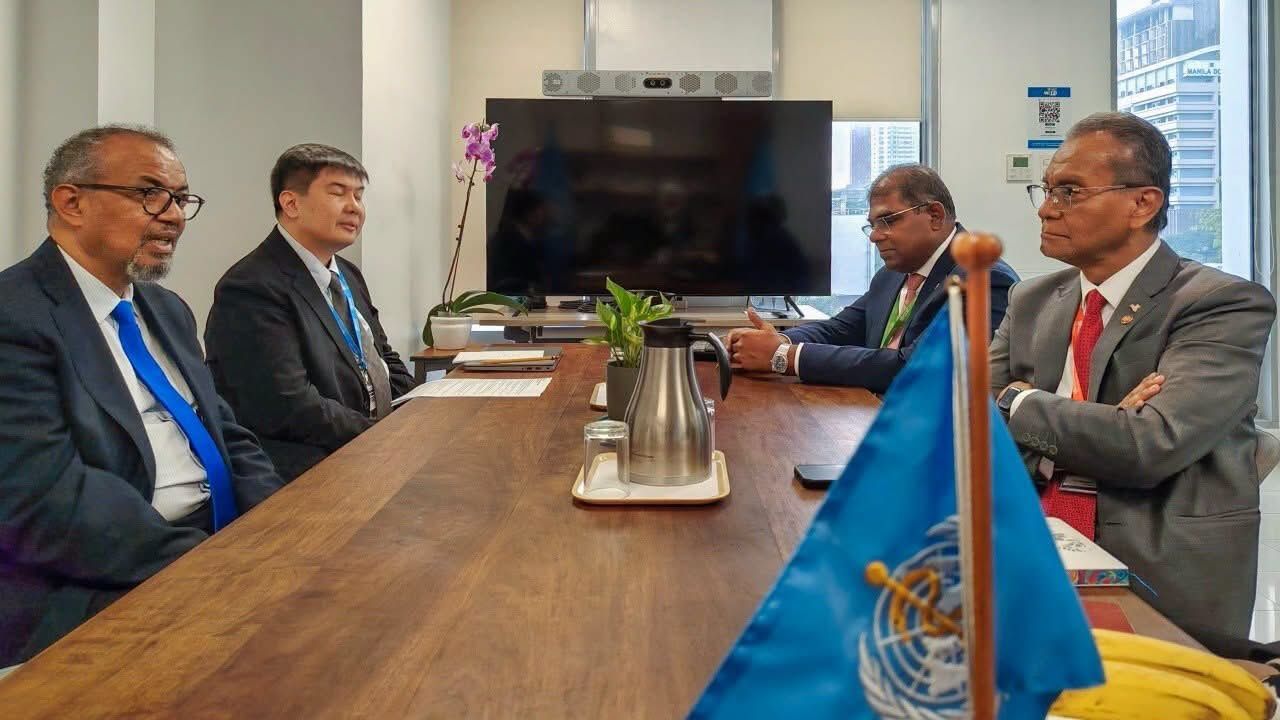
The MOH added that Dr Dzulkefly also held bilateral meetings with Tedros and Saia to discuss efforts to finalise the WHO Pandemic Agreement by May next year, emphasising the need for a balanced solution that protects intellectual property rights while ensuring equitable access to medical supplies.
During the meetings, the WHO also invited Malaysia to lead efforts to build consensus on global emergency preparedness in the Western Pacific Region.
The minister also met two candidates for the post of WHO Director-General: Indonesia’s Budi Gunadi Sadikin and Qatar’s Dr Hanan Mohamed Al Kuwari.
In the Country Statement, he also expressed appreciation for Tedros’ decade of leadership as WHO Director-General and outlined Malaysia’s commitment, as Chair of the 17th ASEAN Health Ministers Meeting, to spearheading the ASEAN Drug Security and Self-Reliance (ADSSR) initiative.
Malaysia remains committed to strengthening global health leadership, particularly in securing medicine supply chains and ensuring equitable access to treatment.
“Malaysia calls on member states to move from advice to action to protect the safety and well-being of communities worldwide without leaving anyone behind, in line with the principle of leaving no one behind,” it said.
The 77RCM WPR also discussed various regional health issues, including healthy ageing, artificial intelligence, digital health, research and innovation, and tobacco control.