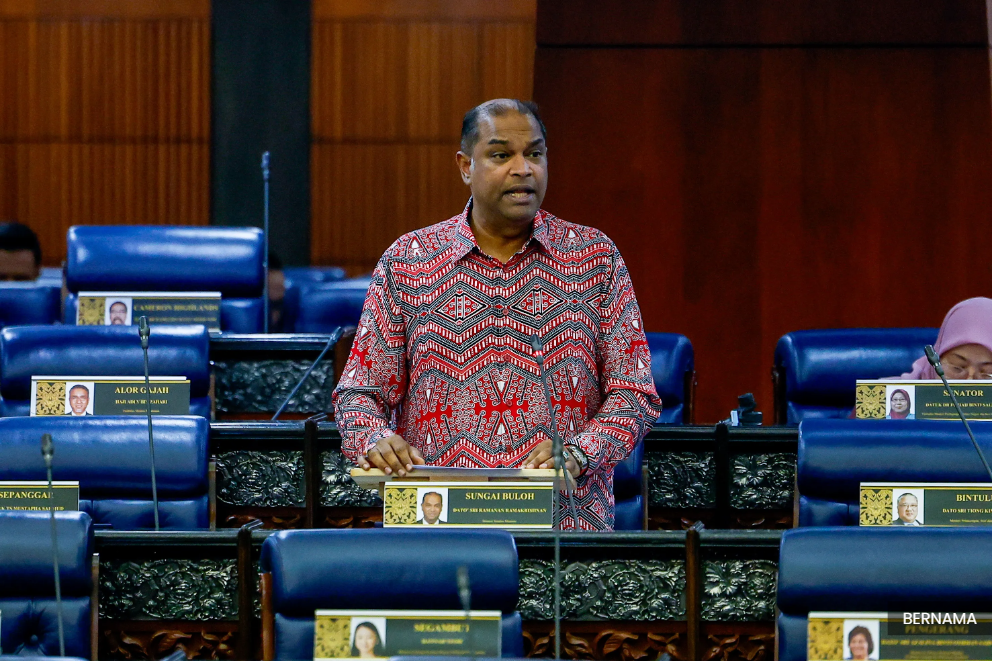
SHAH ALAM, Aug 18 — The government is reviewing the minimum wage to decide whether to maintain the current RM1,700 rate or to set it higher, says Human Resources Minister Datuk Seri Ramanan Ramakrishnan.
Utusan Malaysia reported that the review is in accordance with Section 25 of the National Wage Consultative Council Act 2011, and the final decision will be made after the process of setting the new rate is finalised by the National Wage and Gig Consultative Council (MPGGN).
He said the review also took into account basic indicators: the Poverty Line Income and median salary, to measure the basic needs of workers and the ability of employers to pay wages.
The rate was set based on adjustment indicators taking into account the Consumer Price Index, labour productivity, and unemployment rate.
Ramanan added that the ministry has not conducted a specific study on the living wage.
“However, Bank Negara introduced the concept of a living wage in 2018 by estimating a living wage in Kuala Lumpur, for example, at RM2,700 for a single individual.
“The Basic Living Expenses were introduced by the Statistics Department where the rates are more granular according to location, demographics and actual household spending patterns,” he said during an interview yesterday.
Ramanan noted that the 13th Malaysia Plan also outlined a labour market reform strategy, among others accelerating wage adjustments through minimum wage revisions taking into account the living wage and will be recommended to the government for the future minimum wage.
The current minimum wage rate is set at RM1,700 per month which was enforced in August 2025 after being reviewed once every two years.
The government has also introduced the Progressive Wage Policy (PWP) as a complement to the minimum wage model and productivity-based wage system.
So far, 5,910 employers have applied through the Progressive Wages System with 4,025 employers or 68.1 percent have increased their employees' salaries and submitted Progressive Wages incentive claims.
The system has benefited 51,363 employees, exceeding the initial target of 50,000 employees.
He said the government has successfully disbursed Progressive Wages incentive payments of more than RM73 million, comprising approximately RM10.2 million paid to the entry-level employee category, while RM62.9 million was disbursed to non-entry-level staff.
“Companies that are registered and meet the Progressive Wage conditions and criteria will receive incentives totaling a maximum of RM200 per month for the entry-level group of workers who have worked for 12 months.
“While a maximum of RM300 per month for the non-entry-level group of workers who have worked for more than 12 months.
“The amount of incentives given to companies will be determined by the government based on the country's fiscal position,” Ramanan said.
Through Progressive Salary, employees are encouraged to take up training classes to improve their skills and work efficiency and must meet the minimum requirement of 21 training hours.
“Employers are encouraged to offer salary increases in line with the improvement of skills, use of technology, and digital-based work practices.
“This approach not only increases the productivity and competitiveness of companies, but also accelerates the country's transition towards a high-value digital economy,” he said.
Simultaneously, the ministry is encouraging employers to offer higher salaries through the implementation of the Productivity-Based Wage System, in addition to intensifying the union-based salary model through the Collective Agreement.
“This policy not only targets more meaningful wage increases, but also acts as a mechanism to increase labour productivity as wage increases under the PWP are conditional on workers’ participation in recognised skills upgrading training,” Ramanan said.