By Yasmin Ramlan
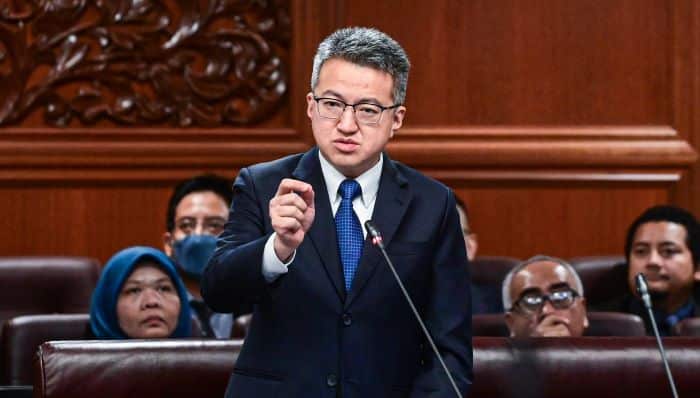
SHAH ALAM, July 29 — The government has no plans to reintroduce the Goods and Services Tax (GST) for now, maintaining that the consumption tax is regressive and would disproportionately burden lower- and middle-income Malaysians, Deputy Finance Minister Liew Chin Tong said.
Responding to a supplementary question from Senator Robert Lau on whether the government was considering reinstating the tax, Liew said although GST is often regarded as a fair and efficient tax system, international evidence shows it places a heavier burden on lower-income groups.
"The government's position is that we do not intend to bring back GST for now because, if it is implemented under the current circumstances, it will affect the livelihoods of lower-income earners as well as the middle class.
"Although many believe GST is fair, the literature and global experience agree that GST is a regressive tax system," he said during Question Time in the Dewan Negara today.
GST was introduced on April 1, 2015, at a rate of six per cent under former prime minister Datuk Seri Najib Razak. It was zero-rated on June 1, 2018, following Barisan Nasional's defeat in the 14th General Election, in line with Pakatan Harapan's election pledge to abolish the tax.
The tax was formally abolished on Aug 31, 2018, with the Sales and Services Tax (SST) reintroduced the following day.
Liew explained that GST is levied on consumption rather than income, meaning individuals with vastly different earnings could pay the same amount of tax if they spend the same amount.
"As long as three people each spend RM2,000, they pay the same amount of tax even if one earns RM20,000 a month, another RM5,000 and another RM2,000, because the tax is based on consumption, not income," he said.
He added that the government would only consider reintroducing GST when Malaysia has a larger middle-class population.
"That is the basis of the Prime Minister's (Datuk Seri Anwar Ibrahim) position. If the median monthly wage reaches RM4,000, we can consider implementing GST," he said.
According to the Department of Statistics Malaysia (DOSM), the national median monthly wage for formal sector employees stood at RM3,167 as of December 2025. Kuala Lumpur recorded the highest median monthly wage at RM4,391, followed by Penang (RM3,500) and Selangor (RM3,400).
Debt remains manageable
On a separate matter, Liew said the federal government's debt-to-gross domestic product (GDP) ratio stood at 63.1 per cent at the end of March this year, down from 65.2 per cent at the end of 2025, reflecting continued fiscal consolidation efforts.
He said the government remained committed to strengthening the country's fiscal position while ensuring debt remained manageable without undermining economic growth and public well-being.
According to Liew, the federal fiscal deficit had narrowed for five consecutive years, from 6.4 per cent of GDP in 2021 to 3.7 per cent in 2025.
He also said new government borrowings declined from RM100 billion in both 2021 and 2022 to RM75.6 billion in 2025.
Liew said Malaysia continues to comply with all statutory debt limits and remains committed to the targets under the Public Finance and Fiscal Responsibility Act 2023, including reducing the fiscal deficit to below three per cent of GDP and keeping federal government debt below 60 per cent of GDP over the medium term.
He stressed that sustainable debt management depends not only on prudent borrowing but also on stronger economic growth.
"We have seen the advance estimate for second-quarter GDP growth reach 5.8 per cent, which is very encouraging. As the economy expands, our debt-to-GDP ratio will also decline," he said.