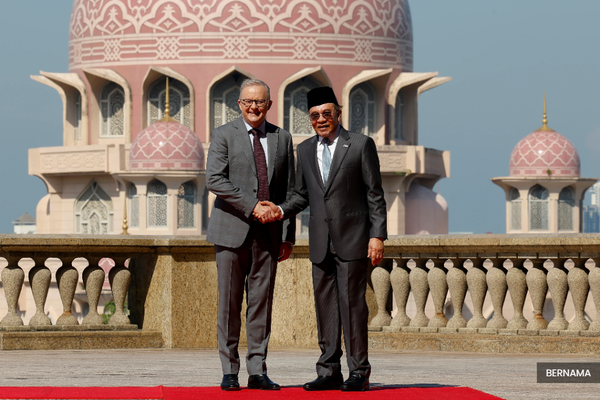
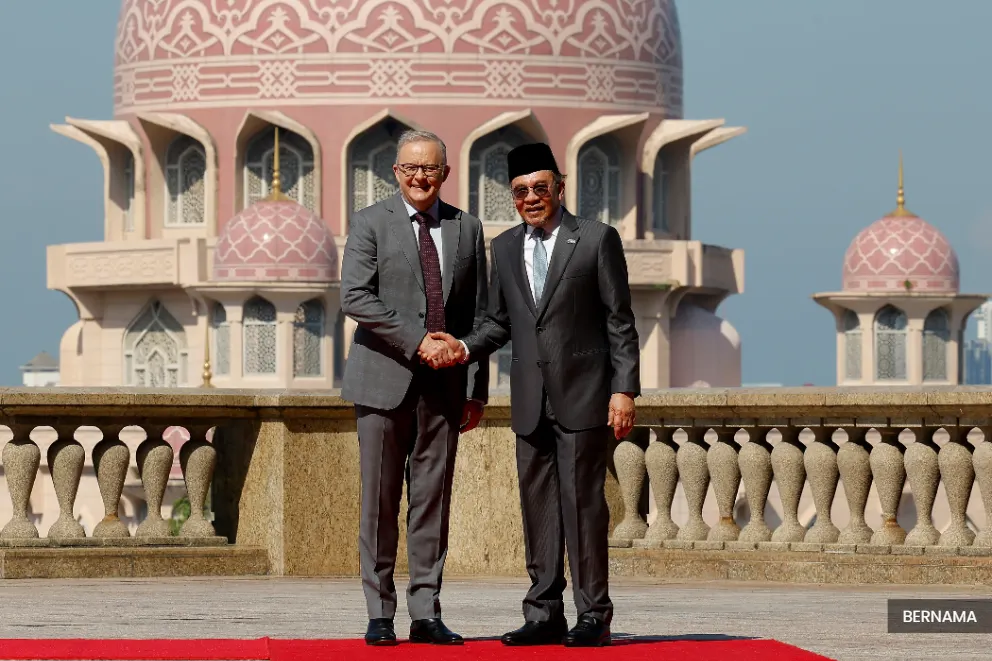
PUTRAJAYA, Apr 16 — Prime Minister Datuk Seri Anwar Ibrahim today held a four-eyed meeting with his Australian counterpart Anthony Albanese, centred on strengthening bilateral ties and addressing emerging energy security challenges amid ongoing geopolitical tensions in West Asia.
The meeting was held shortly after Albanese was accorded an official welcome at the Perdana Putra Complex, in conjunction with his three-day official visit to Malaysia from April 15 to 17.
Both leaders are expected to discuss the conflict in West Asia and its spillover effects on global energy markets, particularly potential disruption to energy supply chains and international trade routes that could weigh on regional economic stability.
They are also expected to exchange views on strengthening cooperation in energy security, including ensuring supply stability, strengthening infrastructure resilience, and exploring opportunities in renewable energy and clean technologies.
The four-eyed meeting will be followed by a bilateral meeting involving senior ministers and officials from both countries, where progress under the Malaysia-Australia Comprehensive Strategic Partnership (CSP) established in 2021 will be reviewed.
Australia remains a key economic partner for Malaysia, ranking as its 12th largest trading partner in 2025, with total bilateral trade valued at RM78.63 billion (US$18.38 billion). Of this, Malaysia’s exports stood at RM48.64 billion (US$11.37 billion), while imports totalled RM29.99 billion (US$7 billion).
Beyond trade, the relationship is underpinned by strong energy interdependence.
Based on 2025 bilateral data, Australia supplies about 96 per cent of Malaysia’s imported liquefied natural gas (LNG), a critical component in supporting the gas network in Peninsular Malaysia and advancing the National Energy Transition Roadmap (NETR).
At the same time, Malaysia is a key supplier of fuel to Australia, accounting for approximately 17 per cent of its total fuel imports. These flows reflect established commercial supply chains between the two countries rather than ad hoc arrangements.