
KUALA LUMPUR, March 19 — Malaysia’s inflation rose modestly to 1.4 per cent in February 2026, with the consumer price index (CPI) climbing to 136.0 from 134.1 a year earlier, the Statistics Department (DOSM) said.
In a statement today, chief statistician Datuk Seri Mohd Uzir Mahidin said eight categories recorded slower year-on-year growth compared with January 2026.
These included insurance and financial services at 4.7 per cent (January 2026: 5.5 per cent), education 2.8 per cent (3.2 per cent), restaurant and accommodation services 2.5 per cent (3.0 per cent), and food and beverages 1.3 per cent (1.5 per cent).
Other groups showed marginal increases, with health rising 1.2 per cent (1.4 per cent), housing, water, electricity, gas, and other fuels up 1.1 per cent (1.2 per cent), and information and communication advancing 0.5 per cent (0.7 per cent).
Meanwhile, personal care, social protection, and miscellaneous goods and services increased to 6.9 per cent (6.6 per cent), while alcoholic beverages and tobacco rose to 2.6 per cent (2.5 per cent).
According to DOSM, about 59.7 per cent of items (342 of 573) recorded price increases, of which 333 items (97.4 per cent) increased by 10 per cent or less, while only nine items rose by more than 10 per cent in February 2026.
The remaining 190 items (33.2 per cent) declined, and 41 items remained unchanged.
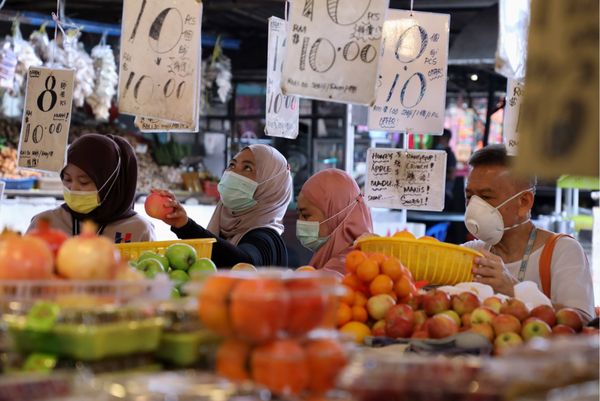
The food and beverages group, which contributes 29.8 per cent of total CPI weight, rose slower at 1.3 per cent in February compared with 1.5 per cent in January, driven by food away from home (2.4 per cent; January: 2.5 per cent) and food at home (0.3 per cent; January: 0.6 per cent).
Inflation in the housing, water, electricity, gas and other fuels group slowed to 1.1 per cent from 1.2 per cent in January, driven by water supply and miscellaneous services related to dwelling, 6.8 per cent (7.1 per cent), and actual rentals for housing, 1.5 per cent (1.9 per cent).
DOSM said the average price of unleaded petrol RON97 remained at RM3.11 per litre in February 2026.
The average price for diesel in Peninsular Malaysia rose to RM2.98 per litre from RM2.89 in January, while in Sabah, Sarawak and Labuan it remained at RM2.15 per litre. The average market price of RON95 increased slightly to RM2.55 per litre (January: RM2.54) compared with the subsidised price of RM1.99.
Uzir said eight states recorded inflation above the national rate of 1.4 per cent: Pahang (2.1 per cent), Federal Territory (FT) Labuan (2.1 per cent), Negeri Sembilan (2.0 per cent), Sabah (1.8 per cent), Johor (1.7 per cent), Pulau Pinang (1.6 per cent), Terengganu (1.6 per cent), and FT Kuala Lumpur (1.6 per cent). Kelantan recorded the lowest inflation at 0.2 per cent.
All states registered higher food and beverage inflation except Kelantan (-0.7 per cent). Seven states exceeded the national food and beverages inflation rate of 1.3 per cent, led by Negeri Sembilan (3.0 per cent), Pahang (2.3 per cent), Johor (2.1 per cent), FT Kuala Lumpur (1.8 per cent), Pulau Pinang (1.7 per cent), Kedah (1.6 per cent) and Melaka (1.4 per cent).
Month-on-month, headline inflation rose 0.2 per cent in February (January: 0.1 per cent), driven by housing, water, electricity, gas and other fuels (0.7 per cent; January: 0.3 per cent), transport (0.2 per cent; -0.4 per cent) and clothing and footwear (0.1 per cent; 0.0 per cent).
Five groups recorded no monthly changes: food and beverages, furnishings and household equipment, health, recreation, sport and culture, and insurance and financial services.
Regionally, Malaysia’s 1.4 per cent inflation in February 2026 was lower than Indonesia (4.8 per cent), Vietnam (3.4 per cent), the Philippines (2.4 per cent) and South Korea (2.0 per cent), but higher than China (1.3 per cent) and Thailand (-0.9 per cent).