
By Danial Dzulkifly
SHAH ALAM, May 15 — The Kuala Kubu Baharu by-election provided various insights for politicians and observers alike, but one point has been sparsely mentioned: public apathy towards voting.
This was evident in the low turnout (61.5 per cent) of the 40,226 registered voters — a growing trend in the country's recent elections.
The primary contributor to these low turnouts? The youth.
A recent Institute Darul Ehsan (IDE) survey revealed only 55 per cent of voters aged 18 to 40 cast their ballots in the Kuala Kubu Baharu by-election.
While this figure should not be cause for grave concern, the general consensus among analysts is that more can be done, particularly by political parties, to emphasise the importance of the people’s participation in the democratic process.
Nusantara Academy for Strategic Research senior fellow Dr Azmi Hassan pointed out that the youth segment in many constituencies largely represents out-of-state voters who may not be able or willing to spend time and financial resources to go home to vote.
This is further compounded by the group’s general sentiment that their votes would bear no weight in the makeup of the government, especially if it is just a by-election.
“Data shows that, most probably, these (youth) are outstation voters. For them to travel from Kuala Lumpur, for example, and especially if they do not have family in Kuala Kubu Baharu, it’s going to take effort, time and money.
“They also think there is no point in coming back to vote if the result does not lead to anything substantial,” he told Selangor Journal.
Azmi said this lack of a make-or-break component in the by-election contributed to lower turnout among the youth, despite them being the most vocal online.
“The younger generation is very active in expressing their opinions about political activities and issues online. But whether this translates into actual voting, which requires sacrificing time and money, is another matter.
“Had there been something more significant at stake in the Kuala Kubu Baharu by-election, like a potential change in the state government, I believe the turnout would have been much higher.”
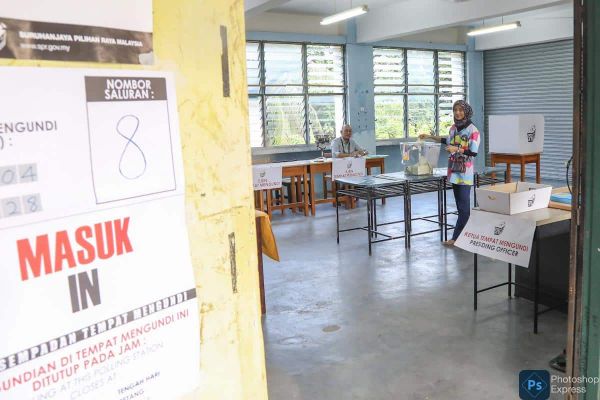
 A mother who had just given birth casts her ballot at SMK Dato’ Haji Kamaruddin during the Kuala Kubu Baharu by-election on May 11, 2024. — Picture by REMY ARIFIN/SELANGORKINI
Better engagement online
In recent years, the youth voter segment has become a major bloc in elections after the minimum voting age was lowered from 21 to 18.
Political parties have since scrambled to capture the group’s attention and support.
One notable strategy is the use of social media platforms like TikTok, which has become a primary source of news for many youngsters both domestically and globally.
Many local politicians from major parties have immersed themselves in cultivating a strong online following by curating and posting about their daily activities, challenges and accomplishments.
However, these platforms are rife with misinformation and slander, which many political observers say are tools used by populist politicians to capture votes.
While Azmi lauded politicians for breaking barriers and using social media platforms such as TikTok to better reach and engage with the youth, he also acknowledged the dangers of these platforms in spreading misinformation.
He said politicians have to be more relatable and effectively communicate their policies and ideas to laymen, while parties must engage constructively on these platforms to encourage people to vote.
“In terms of misinformation and slander, we need more common sense from people to seek references and verify information.”
 A woman casts her ballot at SJKC Khing Ming during the Kuala Kubu Baharu by-election on May 11, 2024. — Picture by HAFIZ OTHMAN/SELANGORKINI
Political messaging
Singapore Institute of International Affairs senior fellow Oh Ei Sun said the way political parties frame their messages during campaigns plays a crucial role in increasing voter confidence.
Effective messaging, she said, shows these parties’ priorities for contested seats, and could encourage the people to vote.
Oh said that in urban and semi-urban constituencies, where there is a sense of political maturity, conversations around developmental needs are more important than rhetoric-based campaigns.
She said however for rural seats, apart from policy discussions, voter participation is largely tied to political ideas or narratives.
“In more rural constituencies, ideological concerns remain paramount.”
Oh believes Malaysians’ participation in elections can be considered good, noting that the country’s average voter turnout is higher than in developed countries.
“Nowadays, a 60 to 65 per cent turnout for by-elections has become the norm, and it is comparatively higher than in more advanced countries like the United States, which typically sees turnouts of lower than 50 per cent,” he said.
Oh agreed that a low-stakes by-election would not be able to strongly convince the out-of-state electorate to go home to vote, especially the youth.
IDE, in its survey released yesterday, concluded the 61.5 per cent turnout for the Kuala Kubu Baharu by-election was notably low. In contrast, voter participation in the 15th General Election was 76.9 per cent.
On May 11, Pang Sock Tao from Pakatan Harapan won the Kuala Kubu Baharu by-election with a majority of 3,869 votes. She secured 14,000 votes, with her closest contender, Perikatan Nasional’s Khairul Azhari Saut, receiving 10,131.