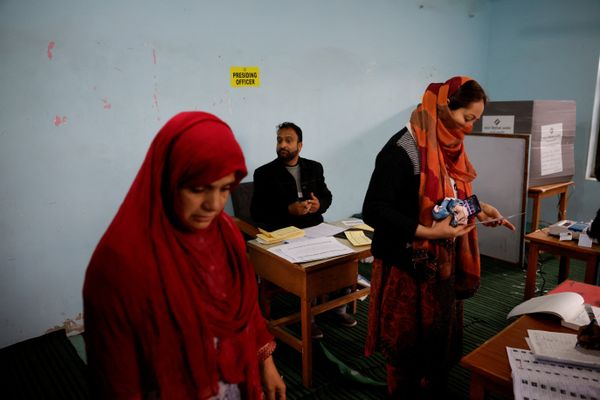

HYDERABAD/SRINAGAR, May 13 — India voted today in the fourth phase of a seven-week general election, as campaign rhetoric became more strident over economic disparities and religious divisions while soaring summer temperatures presented a challenge for some voters.
The world’s most populous nation began voting on April 19 in a seven-phase election, in which nearly one billion people are eligible to vote, with ballots set to be counted on June 4.
Prime Minister Narendra Modi is seeking a rare, third straight term in a contest which pits his Hindu nationalist Bharatiya Janata Party (BJP) against an alliance of more than two dozen opposition parties, including main rival the Congress Party.
“I appeal to all to vote for a decisive government,” said Amit Shah, Modi’s powerful aide and the country’s Home Affairs Minister, as voting began.
Polling will be held today for 96 seats in 10 states and territories, largely covering the southern and eastern states of Telangana, Andhra Pradesh and Odisha, where the BJP is not as strong as other parts of the country.
Srinagar, the main city of the troubled Kashmir Valley, is also voting for the first time since Modi’s 2019 move to remove its semi-autonomy. BJP, however, is not contesting there, as analysts said the outcome was likely to contradict Modi’s narrative of a peaceful, more integrated Kashmir since 2019.
Police imposed restrictions on gatherings ahead of the vote in the militarised region, while opposition parties said their workers were arrested, which police denied.
Former Jammu and Kashmir state Chief Minister Farooq Abdullah, president of the National Conference party, said Modi and Shah “will definitely get defeated” nationally.
Asaduddin Owaisi, a prominent Muslim lawmaker contesting from the southern city of Hyderabad, which also voted today, said the BJP had fewer supporters after Modi’s recent “venomous” comments against minority Muslims.
“An individual cannot be bigger than the country, so Modi is not the country. A country is way bigger than any politician,” he said.
Modi has said he does not oppose Muslims and his government does not discriminate against them.
‘Hindus vs Muslims’
Analysts have raised doubts over whether BJP and its allies can win the landslide predicted by opinion polls, and said the lower turnout had prompted Modi to change the tack of his campaign after the first phase.
Modi has shifted the campaign’s focus from his economic record to accusing the Congress Party of planning to extend welfare benefits to Muslims at the expense of disadvantaged tribal groups and Hindu castes.
Last month, he said the Congress Party planned to redistribute the wealth of majority Hindus among Muslims, who he referred to as “infiltrators” who have “more children”.
The Congress Party has denied making any such promises and has said Modi is rattled by the turnout, which the BJP denies.
About 80% of India’s 1.4 billion people are Hindus but it also has the world’s third-largest Muslim population of about 200 million people. Surveys suggest voters are most concerned about unemployment and price rises.
The Congress Party is pitching for better representation and welfare programmes for India’s poor and disadvantaged groups, stating that wealth inequality has worsened during Modi’s 10-year term, a charge rejected by the government.
“Do not get deterred by the diversionary tactics of hateful speeches which divide the society,” party president Mallikarjun Kharge said in a social media post.
The opposition Indian National Developmental Inclusive Alliance, led by the Congress Party, got a shot in the arm ahead of today’s vote when the Supreme Court gave temporary bail to Arvind Kejriwal, Chief Minister of the national capital territory of Delhi and a key opposition leader, allowing him to campaign.
The impact of hot weather on voting is also being monitored with maximums in many parts of the country touching 40ºC or higher in the past week, although the weather department expects temperatures to be normal during today’s vote.
— Reuters