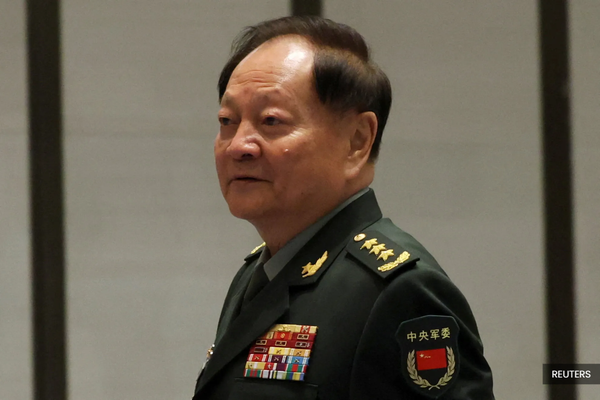
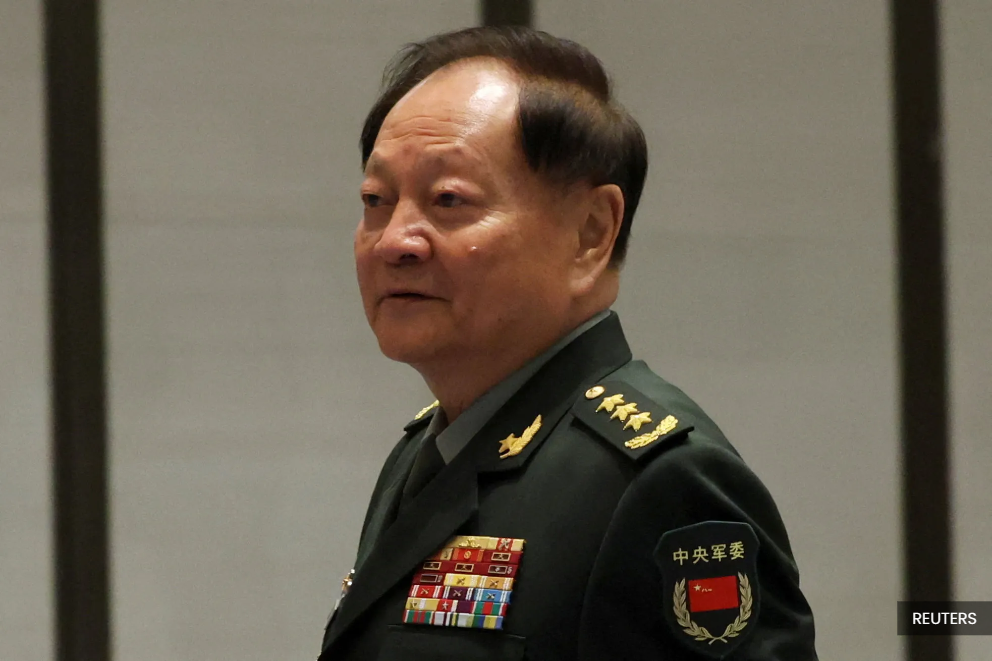
WASHINGTON/BEIJING, Jan 28 — With the downfall of China's top general, the United States (US) has lost an important contact within Beijing's top military body and now faces a People's Liberation Army that increasingly lacks steady, experienced commanders, former US officials and analysts said.
On Saturday, China's Defense Ministry said that Zhang Youxia, second-in-command under President Xi Jinping as vice-chairman of the Central Military Commission (CMC), is under investigation. It is the latest and highest-profile purge of the country's top military leadership amid Xi's crackdown on corruption in the armed forces.
For Washington, his surprising demise removes a respected and well-known figure within China's military at a time when successive US administrations have worked to build senior-level contacts to avoid mishaps between the world's two most powerful militaries.
Several former senior US officials told Reuters that Zhang's dismissal came as a shock.
Xi allowed Zhang to communicate with the US during the Biden administration after a 17-month-long period during which China had cut off nearly all military-to-military communications following a visit to Taiwan by then-US House of Representatives Speaker Nancy Pelosi.
Such a senior-level connection — in China's political system, he outranks the defence minister — was seen as an important relationship and a channel that remained viable for further talks.
One of just a few leading officers with combat experience from China's invasion of Vietnam in the late 1970s, Zhang was seen in the US as a competent adviser to Xi, who sits atop the Central Military Commission, now staffed by only one general, career political commissar Zhang Shengmin.
"Who does Xi Jinping convene in a crisis if there is only one person on his commission?" Singapore-based S. Rajaratnam School of International Studies' senior fellow Drew Thompson, who engaged with Zhang as a former US defence official.
He added that he believed Zhang was the one active-duty PLA officer who could give Xi objective advice about China's military capabilities and shortcomings, as well as the human cost of conflict.
"There is a risk that Xi Jinping is given bad advice by sycophants who tell him what he wants to hear. That creates a risk of miscalculation," Thompson said.
A senior US administration official said the White House had nothing to share regarding "reports of palace intrigue" in China, adding that the Trump administration is "building a military capable of denying aggression anywhere in the First Island Chain."
The Pentagon did not respond to a request for comment.
"The more resolutely the People's Armed Forces fight corruption, the stronger, more united, and capable they become," said China's Embassy in Washington spokesman Liu Pengyu in response to Reuters' questions on Zhang.
Need for insight as the PLA modernizes
US Defence Secretary Pete Hegseth has held talks multiple times with China's Defence Minister Dong Jun, who does not sit on the CMC, since September, part of Washington's efforts to improve communications with China over its military modernisation, nuclear weapons buildup, and more aggressive posture toward American allies and actions in the Indo-Pacific.
But US officials have long prized contact with vice chairs of the CMC over the country's Defence Ministry, which lacks command authority over China's armed forces.
Among senior Chinese generals, Zhang was a known quantity to US officials, having joined a week-long military delegation to the US in May 2012 when he was a lower-level general.
Former US Air Force general David Stilwell, who served as the State Department's top diplomat for East Asia in the first Trump administration, recalls that Zhang was the only Chinese officer who wanted to fly in one of the US military's Osprey aircraft on that trip.
"He is very different from his fellow PLA brothers. He could have fit in very well in the US military," he said, noting that he was keen to talk to American soldiers and try out US weapons, and struck the Americans as a professional rather than political soldier.
Still, Stilwell noted that senior-level engagement with CMC generals was typically perfunctory. Without Zhang to advise Xi, he is concerned that the PLA was more likely to believe a self-constructed narrative that they were ready for a "Taiwan adventure."
"I think what you lose with Zhang Youxia gone is a voice of reason," he said.
US interactions with senior CMC generals have been infrequent in bilateral diplomacy over the past two decades. Biden administration national security advisor Jake Sullivan was the last known senior US official to meet Zhang when the two held talks in August 2024 in Beijing.
Washington-based security consultancy BluePath Labs' Chinese military expert Eric Hundman said military-to-military exchanges under Xi, even at the CMC level, tended to be scripted.
"The PLA knows its capabilities fairly well and is not interested in moving on Taiwan before they think they are ready. My question mark has always been how much Xi Jinping listens to them on that point.
"To the degree that he is getting worse advice, that would worry me," he said.