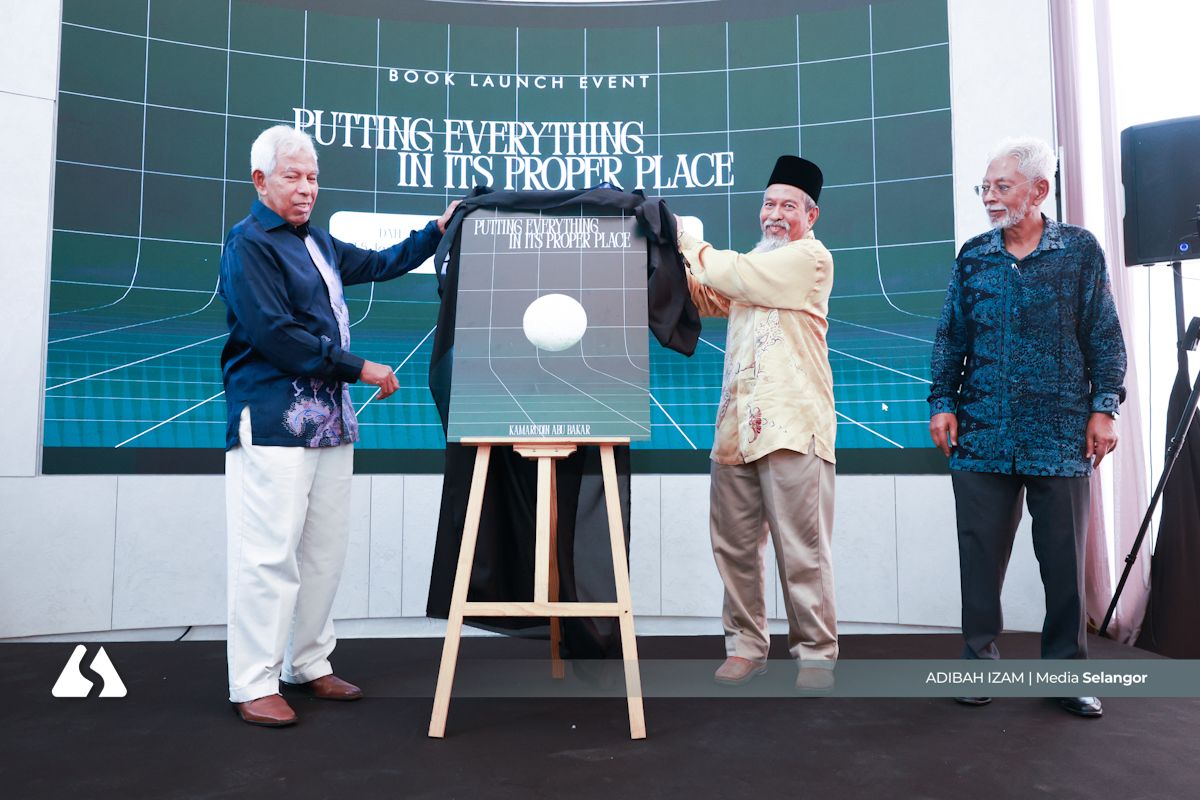


KUALA LUMPUR, Jan 16 — As many young Malaysians grapple with rising living costs and economic uncertainty, former banking industry corporate leader Kamarudin Abu Bakar is urging a deeper understanding of how the modern economy truly functions, beginning with a reassessment of how money is perceived and used.
He said that many of today’s economic challenges stem from a lack of understanding and widespread misconceptions about the true role of money in society.
“Many people blame inflation and a weakening currency on the government, but in reality, these outcomes are built into the system itself,” he said during the media conference after the launch of his book Putting Everything in Its Proper Place, at Zezz Residence in Country Heights Damansara yesterday.
Kamarudin, who has over 30 years of experience in the industry, said his book compiles 17 years of his writings on economics, Islamic banking, and society from both personal reflection and professional experience.
It encourages readers to look beyond surface differences in financial systems and focus instead on understanding how money and economic structures actually function.
He added that many of today’s economic pressures, including inflation and currency fluctuations, are often misunderstood and cannot be attributed solely to policy decisions.
“Money was meant to be a tool for exchange, not the centre of our lives. When people understand how the system works, they begin to see that these problems are much bigger than individual policies,” Kamarudin said, noting that economic systems should be examined for how they shape behaviour, inequality, and long-term stability.
Drawing on the philosophy of Malaysian philosopher and Islamic scholar Syed Muhammad Naquib al-Attas, he said the book highlights justice as “putting everything in its proper place”, including how society understands money.
“Money is merely a medium of exchange. It is not something we should treat as the ultimate goal,” Kamarudin said.
Dedicating the book to young readers, he hopes it encourages them to recognise how much there is still to learn, and to pursue honest, sustainable livelihoods rather than relying on subsidies, corruption or shortcuts.
“If you want to survive, you must be able to do something that others are willing to pay for. That means nurturing real skills and doing work the right way,” Kamarudin said.
He added that the book integrates various aspects of his life, including work, faith, finances and family. It is also intended to encourage readers to rethink values, justice, and economic priorities in a modern world.