

PUTRAJAYA, Dec 23 — Malaysia’s agricultural sector employed about 1.74 million people in 2023, with the crops subsector remaining the country’s largest source of agricultural jobs, said Chief Statistician Datuk Seri Mohd Uzir Mahidin.
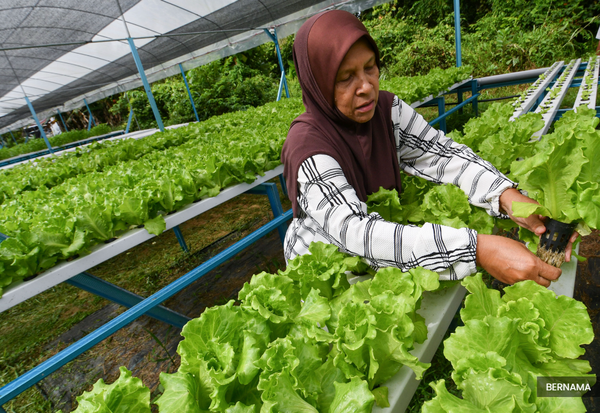
Crops accounted for 76.3 per cent of total agricultural employment, underscoring the sector’s critical role in sustaining household incomes.
“Overall, agriculture generated RM186.43 billion in income in 2023. The crops subsector led with RM132.06 billion, or 70.8 per cent of total sector income, while livestock contributed RM33.12 billion, followed by marine capture fisheries at RM11.08 billion, forestry and logging at RM5.42 billion, and aquaculture at RM4.74 billion,” he said during the online launch of the 2024 Agricultural Census Report today.
Uzir added that the census, conducted by the Malaysian Statistics Department (DOSM) from July 7 to October 31 last year, introduced new parameters covering income, expenditure, salaries, and wages for the 2023 reference year.
The exercise involved strategic collaboration with 1,390 agriculture-related agencies at the Federal, state, and district levels.
It recorded 1.03 million agricultural holdings, of which 97.9 per cent were operated by individuals and the remainder by organisations.
“Growth in agricultural holdings and activities was driven by strong food demand, global climate change, and wider adoption of modern technologies such as the Internet of Things (IoT) and smart farming, which have also attracted more young people to the sector,” he said.
Malaysia has an estimated 7.5 million hectares of agricultural land, dominated by oil palm plantations (5.8 million hectares), followed by rubber (0.7 million hectares), and paddy (0.5 million hectares).
In terms of sales value, crops accounted for RM116.7 billion, livestock for RM26.9 billion, and marine capture fisheries for RM10.9 billion. Crop income was led by oil palm at RM92.68 billion, followed by fruits (RM14.15 billion), vegetables (RM10.90 billion), rubber (RM4.27 billion), paddy (RM3.84 billion), and pineapple (RM2.33 billion).
Within livestock, chicken and duck farming generated the highest income at RM20.83 billion, followed by egg production at RM5.54 billion, and pig farming at RM2.55 billion.
Uzir noted that Johor recorded the highest total agricultural income at RM30.15 billion, followed by Sarawak (RM29.18 billion), and Sabah (RM28.22 billion).
For the crops subsector, Pahang, Sarawak, and Sabah were the top contributors, generating RM24.05 billion, RM23.58 billion and RM23.43 billion, respectively.
Total agricultural expenditure stood at RM67.89 billion, with crops accounting for the largest share at RM41.53 billion. The expenditure-to-income ratio of 0.36 indicates that about one-third of sector income was spent on operating costs.
In terms of employment, Sarawak recorded the highest number of agricultural workers at 358,803, followed by Sabah (281,116), Johor (210,575), Perak (194,316), and Pahang (193,216).