NANJING, Dec 13 — China held a low-key memorial ceremony today for the 1937 Nanjing Massacre, with President Xi Jinping absent, despite a diplomatic crisis between Beijing and Tokyo over Taiwan.
Beijing has raged at Tokyo since Prime Minister Sanae Takaichi said last month that a hypothetical Chinese attack on Chinese-claimed Taiwan could trigger a military response from Japan.
China and Japan have long sparred over their painful history. China consistently reminds its people of the 1937 Nanjing Massacre, in which it says Japanese troops killed 300,000 people in what was then its capital.
A post-World War II Allied tribunal put the death toll in the eastern city of Nanjing at 142,000, but some conservative Japanese politicians and scholars have denied a massacre took place at all.
Memorial ceremony
During today’s ceremony at the national memorial centre in Nanjing, Shi Taifeng, head of the ruling Communist Party’s powerful organisation department, referenced Xi’s speech at a military parade in Beijing in September marking 80 years since the end of World War II.
But Shi’s remarks were far less combative than recent rhetoric from Chinese government officials.
“History has fully demonstrated that the Chinese nation is a great nation that fears no power and stands on its own feet,” he said.
He did not mention Takaichi but alluded to China’s previous claims that she seeks to revive Japan’s history of militarism.
“History has proven and will continue to prove that any attempt to revive militarism, challenge the post-war international order, or undermine world peace and stability will never be tolerated by all peace-loving and justice-seeking peoples around the world and is doomed to fail.”
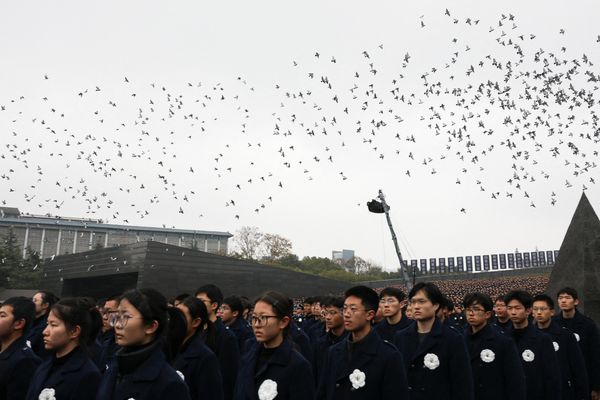
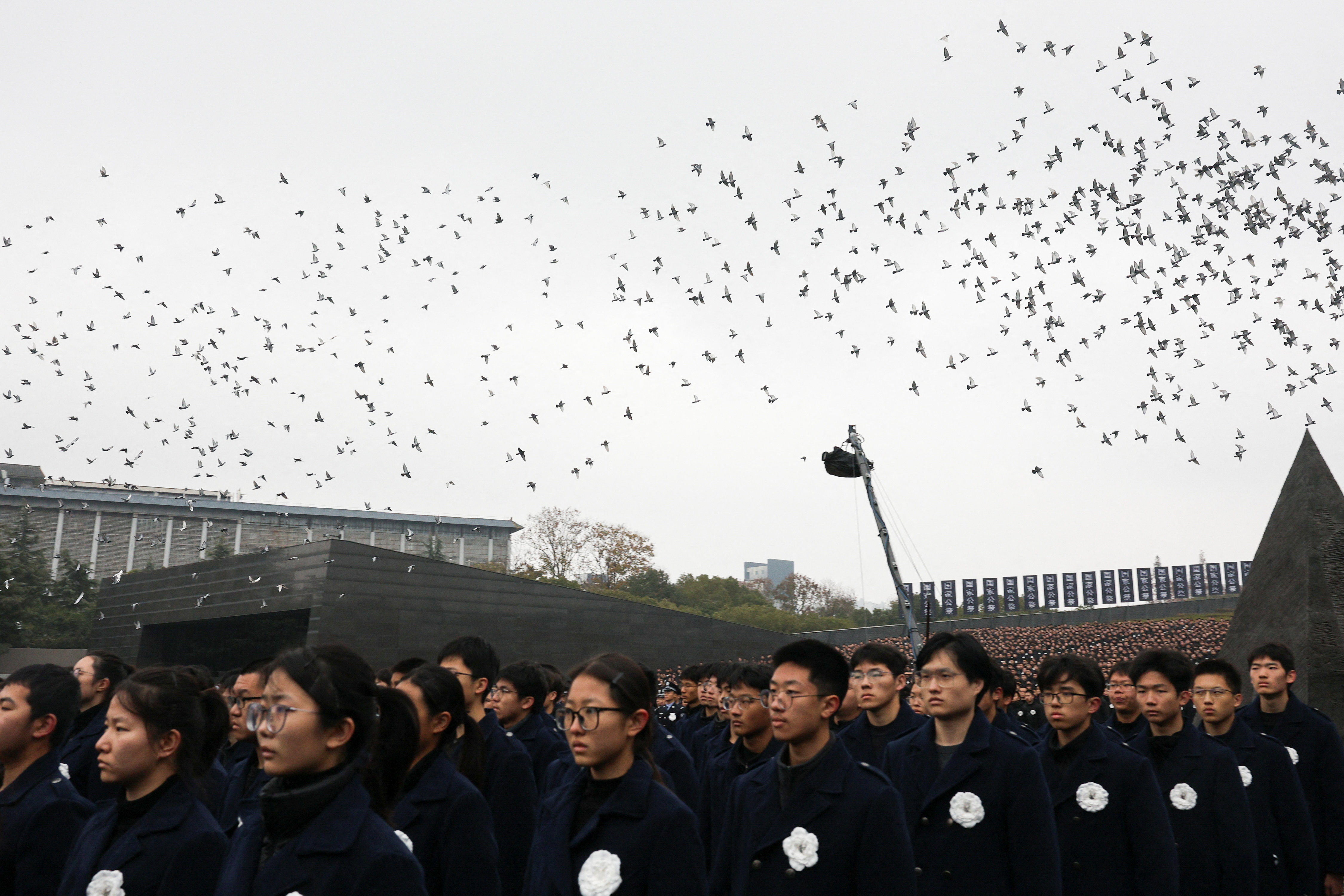
Doves flew over the site after the ceremony, which was completed in less than half an hour, in front of an audience that included police officers and schoolchildren.
Xi last attended event in 2017
China marked its first national memorial day for the massacre in 2014, where Xi spoke and called on China and Japan to set aside hatred and not allow the minority who led Japan to war to affect relations now.
Xi last attended the event in person in 2017 but did not deliver public remarks.
China’s State Council Information Office, which handles questions from foreign media to the central government, did not immediately respond to a request for comment on Xi’s absence.
Still, the Eastern Theatre Command of China’s People’s Liberation Army put out a picture on its social media accounts today of a large bloody sword, of the type used by many Chinese soldiers during the war, chopping off the head of a skeleton wearing a Japanese army cap.
“For nearly 1,000 years, the eastern dwarves have brought calamity; the sea of blood and deep hatred are still before our very eyes,” it said, using an old expression for Japan.