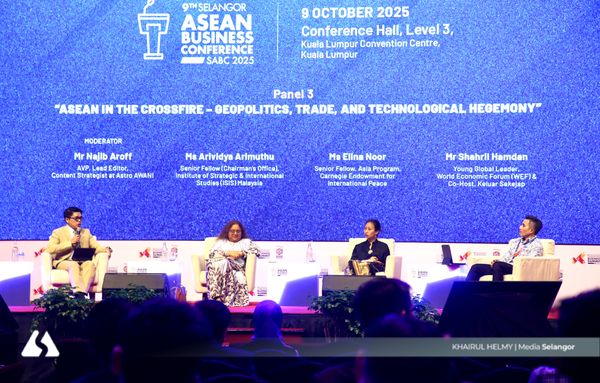
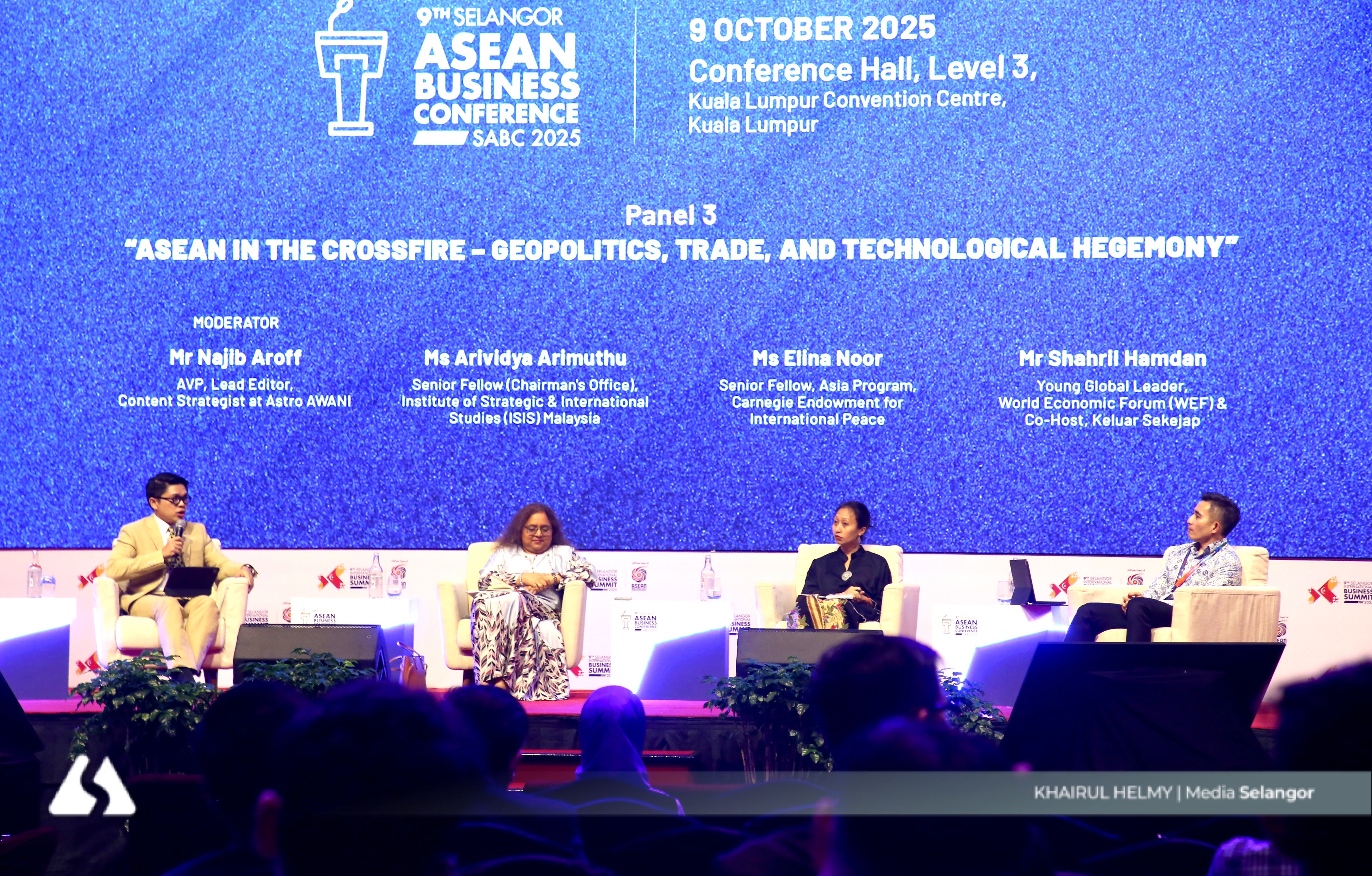
KUALA LUMPUR, Oct 11 — Stronger privacy and data governance frameworks are needed across Asean to ensure technology progress serves the people, not just investors or major powers, said Carnegie Endowment for International Peace senior fellow Elina Noor.
Speaking at the Asean in the Crossfire: Geopolitics, Trade, and Technological Hegemony forum yesterday, she said that while Asean nations are eager to attract digital investments, the region must take a step back to consider who ultimately benefits from these rapid developments.
“If it is the people who are to benefit from technological advancement and development, then we need to ask ourselves some very uncomfortable questions, not only around data, but also the digital infrastructure that facilitates and powers these data-driven technologies,” she said.
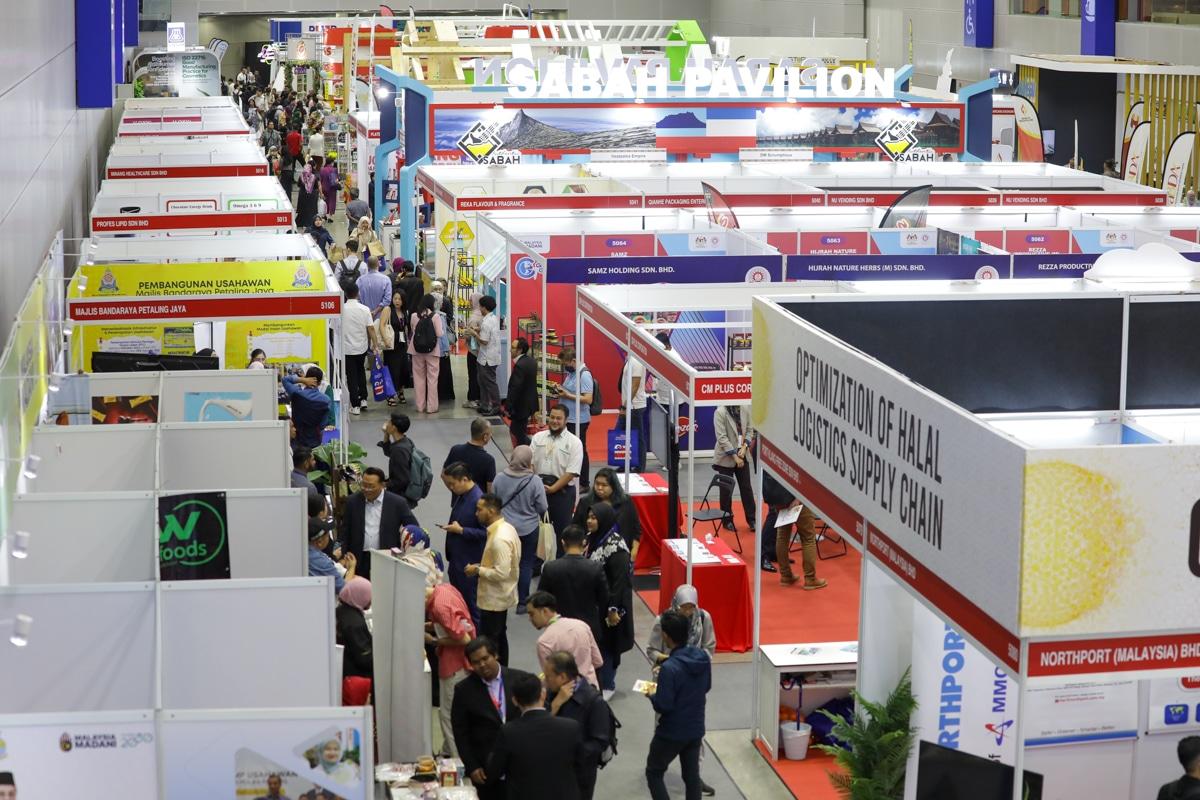
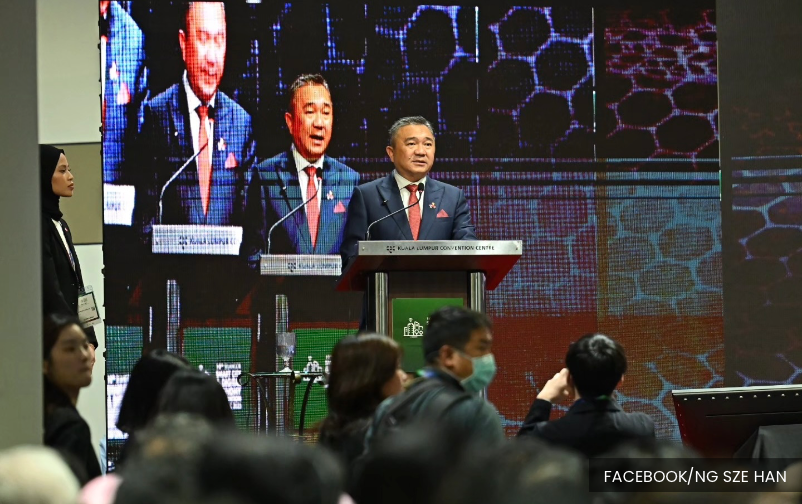
Elina was speaking at the Selangor Asean Business Conference (SABC), held in conjunction with the Selangor International Business Summit (SIBS) at the Kuala Lumpur Convention Centre here on Thursday.
She said many Asean countries have personal data protection laws, but the region lacks comprehensive privacy and security legislation.
“Data protection is not the same as data security, and neither is the same as privacy. These are things we need to look into more carefully if we’re serious about the data-driven technologies we are investing in,” she said.
Elina also urged Asean policymakers to rethink how data is governed, not just at the individual level, but collectively.
“We could be a little more creative in thinking about community data,” she said.
She was referring to emerging discussions in Africa and Latin America that explore broader, community-based approaches to data protection and privacy.

Elina also warned that Southeast Asia’s role in powering the global data economy today echoes its colonial past as a resource hub.
She likened the modern digital infrastructure from submarine data cables to cloud services, to the 19th century to telegraph cables that depended on rubber from the region.
“We have to be very aware that we are not doing the same with our relatively cheap land, labour, energy, and water. Otherwise, we risk repeating history —w here our indispensability benefits others more than ourselves,” she said.
Elina also highlighted the growing intertwining of economic and security considerations in technology policy.
Decisions on data centres, subsea cables, and cloud services are increasingly tied to national security clauses and foreign regulations, such as executive orders or legislative conditions from major powers.
“We no longer have the luxury of separating what is economic or commercial from what is security. This is the reality we now have to deal with and we must be more strategic and proactive in our thinking,” she said.
She added that Asean’s historical position of reacting to external pressures should evolve into one of self-determined, people-centred digital policymaking.
“For too long, we have been in a responsive mode to the international order,” she said. “Perhaps now is the moment to pause and reflect on what we actually want out of this system, if we can afford to,” she said.
Proactive approach
Meanwhile, Institute of Strategic and International Studies (ISIS) Malaysia senior fellow Arividya Arimuthu said Asean must take a more proactive stance in shaping global trade and digital governance, instead of adopting a “wait-and-watch” approach in responding to shifts in the global economic order.
Reflecting on the region’s handling of past trade tensions, she said Asean had shown unity and restraint during the United States’ tariff announcements.
“When Trump first announced his tariffs, Asean was quick to say we will not retaliate. We wanted to discuss, to negotiate, and find an amicable solution. There was a sense of commonality — a shared voice reaffirming Asean’s commitment to the multilateral trading order, however fragmented it may be,” she said.

However, she pointed out that the region’s collective response often stops short of meaningful action, especially on complex issues such as the Indo-Pacific framework, fragmented multilateralism, and new forms of economic coercion.
“There are many instances where Asean has been swift in its response…But there are far more cases where it took a wait-and-watch approach, when it could have been more proactive,” she said.
Arividya emphasised that the current global trading system was not designed to address modern challenges such as predatory state policies, industrial subsidies, and economic coercion, and pointed out that Asean should step forward with reforms.
On the regional trade arrangements, she said it is vital for Asean to remain in the driver’s seat of the Regional Comprehensive Economic Partnership (RCEP) amid competing interests from major powers.
“RCEP began as an Asean-driven process… Now that China and Japan are seeking to shape its next phase, Asean must reassert its leadership and ensure it does not become a vehicle for any single country,” she said.
She also cautioned that while the diversification of export markets remains an important goal, many Asean economies continue to rely heavily on the US market, which accounts for about 30 per cent of global consumer spending.
“Realistically speaking, export-oriented countries in Asean still depend on the US market,“ she said. “That may change in the future, but for now and for the next 10 to 20 years, the region still needs to find a way to work with the US.”