
By Yasmin Ramlan
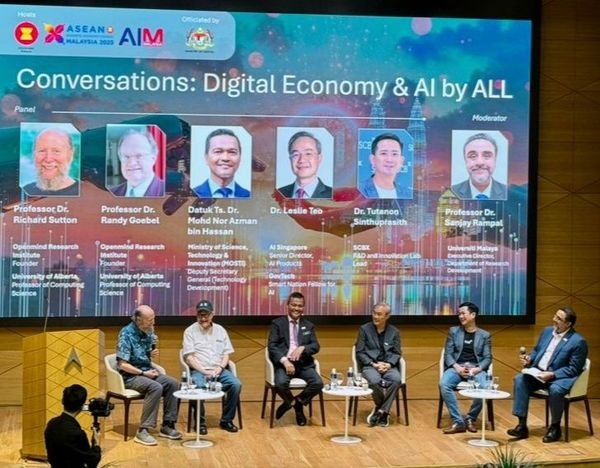
KUALA LUMPUR, May 31 — Artificial intelligence (AI) should be built to serve people, not just businesses, said an expert, who urged more inclusive and purpose-driven innovation to retain global talent and deliver societal benefits.
Openmind Research Institute founder Prof Randy Goebel, drawing from his experience in Malaysia, Japan, and Canada, said his work is driven by a desire to improve people’s lives through technology.
“My passion for AI is about making life better for everyone. It enables everyone to have access to knowledge,” he said during a discussion session in conjunction with the launch of AI Malaysia (AIM) and Inaugural AI Conversations, at the AICB Centre of Excellence here yesterday.
Goebel said attracting and retaining talent, especially youth, requires more than just high wages. Quality of life, meaningful work, and inclusive collaboration matter more today and can influence talent migration and retention, he noted.
He praised Japan’s AI initiatives for focusing on making knowledge accessible to all, and said countries like Malaysia could benefit from a similar approach.
However, Goebel warned against focusing solely on monetisation or startup success.
“When we see successful entrepreneurs, we say: ‘Oh, that’s amazing that they can take research and convert it into value that lifts up a population and a certain part of society,’ but we can be more deliberate in how we (bridge the gap between) universities and industry.
“It’s not just about pushing or pulling, it’s the creation of infrastructure, like a highway, connecting the two,” he said, referring to Germany’s halfway house models like the Fraunhofer Institutes, which support both research and application.
“What I said about my passion for using AI to improve lives can change the dynamics of how you can build relationships to attract people, especially when you talked about redistribution of age.”
 Image for illustration purposes only. — Picture by REUTERS
Keeping real talent
Science, Technology, and Innovation Ministry deputy secretary-general (technology development) Datuk Mohd Nor Azman Hassan said Malaysia must embrace mission-oriented research and development to retain talent.
He said brain drain remains a key challenge for countries like Malaysia, where people are motivated by different factors like financial gain, adding that talent will naturally gravitate toward where opportunities exist.
“People are motivated differently — some by passion, others by financial gain. We need to build systems that support both, and to keep talent, we need to give them meaningful problems to solve.”
Nor Azman shared an example of how AI applications in agriculture empower small farmers by helping them bypass middlemen.
“If we can help them sell directly, they get better prices,” he said, but acknowledged a disconnect between academic and commercial goals.
“Academia is driven by publication and openness, while industry wants exclusivity and intellectual property. That’s a real mismatch we have to fix,” he said.
 Image for illustration purposes only. — Picture via PEXELS
Fixing the culture
Meanwhile, AI Singapore senior director for AI products Leslie Teo said reforming the existing Asian work culture is critical for unlocking innovation.
“Engineers and researchers want to do meaningful things, but our work culture tends to be overly micromanaged and controlling. That has to change,” he said.
He added that talent migration is not simply a matter of brain drain, noting how many people leave and later return with valuable experience.
However, Teo cautioned against oversimplified solutions, such as pressuring professors to start companies merely to meet key performance indicators.
Instead, he suggested bringing in professional entrepreneurs or venture builders to bridge the commercialisation gap.
“We need to find real CEOs — not just researchers forced to wear suits,” he said.
Among other speakers at the forum were Openmind Research Institute co-founder Prof Richard Sutton and SCBX R&D and innovation lab lead Tutanon Sinthuprasith.