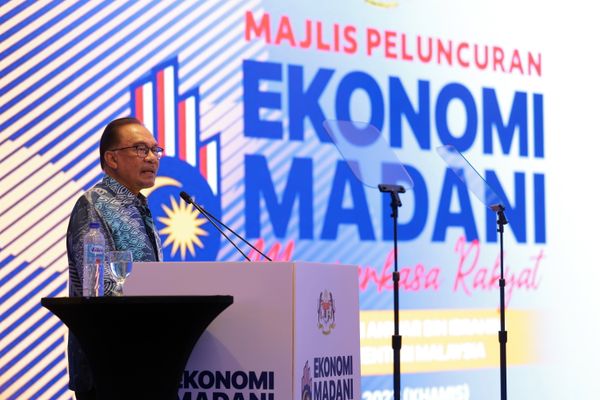

PUTRAJAYA, July 9 — The Madani Economy: Empowering the People initiatives and several new policies that were introduced last year have begun to bear fruit since the beginning of the year, said Prime Minister Datuk Seri Anwar Ibrahim.
Anwar, also Finance Minister, said several reforms have started to show results, evidenced by achievements in economic indicators such as a higher gross domestic product in the first quarter of 2024 at 4.2 per cent, compared with 3 per cent for the fourth quarter of 2023.
Anwar said global rating agencies S&P Global Ratings and Fitch Ratings have also maintained Malaysia’s sovereign credit rating at A- and BBB+, respectively, with a “stable” outlook.
“(Among other achievements are) the recovery of goods exports with a 5.2 per cent growth in the first quarter of 2024, compared with an 8.1 per cent contraction for 2023; and tBursa Malaysia’s FBM KLCI exceeding 1,600 points and achieving a historic milestone of surpassing market capitalisation of RM2 trillion this year.
“The highest achievement with direct investment approved in 2023 was RM329.5 billion, 23 per cent higher compared with 2022,” he said during the Budget 2025 engagement session here today.
He said that last year, several policies and targets were introduced, including the New Industrial Master Plan 2030, the National Energy Transition Roadmap, the 12th Malaysia Plan mid-term review, and the National Semiconductor Strategy.
Anwar said though economic indicators are positive, there is room to improve.
“Last year, as I emphasised, we launched Madani Economy to empower the people and as the main basis for bringing about change, but of course it is also necessary as justification to correct the country’s structural problems.
“Several measures have been implemented, such as the Fiscal Responsibility Act, amendments to the increased role for the heads of the national audit to monitor the finances and continuous measures to improve governance,” he said.
He said to continue empowering Malaysia’s economy, the government has formed economic alliances with other countries, including the Asia-Pacific Economic Cooperation, the Comprehensive and Progressive Agreement for Trans-Pacific Partnership, Free Trade Agreement (FTA), and European Union FTAs.
“We have also agreed to look into joining BRICS and consider the possibility of joining the OECD (Organisation for Economic Cooperation and Development).
“This is to open the best possible space for entrepreneurs, traders, investors from inside and outside to benefit from the available facilities,” he said.
— Bernama